

Securing a reliable packaging supply chain in the European food sector extends far beyond negotiating unit costs. Driven by stringent European Food Safety Authority (EFSA) mandates and aggressive Extended Producer Responsibility (EPR) tax frameworks, procurement directors must heavily vet their upstream partners. When sourcing from an aluminum foil container manufacturer, the audit process must transition from a basic pricing exercise to a deep-dive technical evaluation of metallurgical sourcing, press mechanics, and quality management systems. This guide outlines the critical engineering and compliance benchmarks required to qualify a tier-one supplier for the highly regulated EU market.
EFSA Compliance: Migration Testing and Lubricant Chemistry
European food contact regulations, governed fundamentally by EU Regulation (EC) No 1935/2004, demand absolute biochemical safety. A qualified manufacturer must provide a comprehensive Declaration of Compliance (DoC) demonstrating that their containers do not transfer harmful constituents into the food mass.
This audit begins with the stamping lubricant. During the high-speed deep-drawing process, forming oil is applied to the aluminum coil to prevent galvanic galling against the steel die. If a manufacturer utilizes low-grade, non-volatile industrial oils, chemical residues will remain on the finished tray. Tier-one manufacturers utilize highly refined, food-grade evaporative lubricants applied via automated micro-dosing systems (typically leaving less than 300 mg per square meter). Auditors must verify the Material Safety Data Sheets (MSDS) of these lubricants to ensure they pass Overall Migration Limits (OML) and Specific Migration Limits (SML) testing under European laboratory conditions. SML testing is particularly vital, as it quantifies the migration of specific heavy metals or aromatic amines, ensuring they remain well below the strict parts-per-billion thresholds mandated by the EFSA.
Furthermore, for acidic food applications (such as cherry pies or citrus marinades), the manufacturer must demonstrate proficiency in applying BPA-NI (Bisphenol A Non-Intent) epoxy or polyester lacquers. The audit should review their coil-coating supply chain to confirm that the dry film weight and curing temperatures are strictly controlled to prevent pitting and galvanic corrosion.
Alloy Specification: The Metallurgy of 3003 vs. 8011
A sophisticated manufacturer does not treat aluminum foil as a generic commodity; they engineer the packaging based on specific metallurgical properties. During the facility audit, procurement engineers should assess the supplier's technical aptitude regarding alloy selection. The vast majority of standard takeaway containers are stamped from the 8011 aluminum alloy. This alloy provides an excellent balance of formability and moisture barrier properties, making it the economical workhorse of the food service industry.
However, when a European institutional caterer requires deep-drawn, multi-compartment trays or heavy-duty roasting pans, 8011 often lacks the necessary tensile strength. A highly qualified manufacturer will specify the 3003 alloy, typically in an H24 (half-hard) temper. The 3003 alloy contains higher concentrations of manganese, which drastically increases its mechanical strength and rigidity. This prevents large Gastronorm-sized pans from buckling under heavy 10-kilogram food payloads. Furthermore, for smooth-wall MAP containers, the manufacturer must demonstrate expertise in sourcing and drawing 8006 O-temper (fully annealed) foil, which possesses the extreme elongation properties required to stretch into a deep cavity without wrinkling or fracturing. A manufacturer's ability to match the precise alloy and temper to the physical demands of the food product is a critical indicator of their engineering pedigree.
In-House Tooling: CNC Machining and Mold Development
The physical structure of an aluminum tray is dictated entirely by the precision of the stamping die. A major differentiator between a packaging broker and a true manufacturing partner is the presence of an in-house tooling workshop.
Developing a custom container—whether it features a proprietary embossed brand logo, specialized wrinkle-wall corrugations for structural rigidity, or a multi-compartment layout for aviation catering—requires advanced CNC machining. If an aluminum foil container manufacturer outsources their die creation, lead times for new product development can stretch into months, and quality control over microscopic die clearance is relinquished.
For smooth-wall containers, tooling capabilities are even more critical. Drawing smooth-wall trays from high-elongation alloys requires absolute micron-level precision between the punch and the die cavity to "iron" the metal flat without tearing. Auditors should visually inspect the manufacturer's tool room, looking for wire EDM (Electrical Discharge Machining) equipment and dedicated die-maintenance teams capable of polishing and recalibrating molds immediately after high-volume production runs.

High-Tonnage Press Infrastructure and Servo Automation
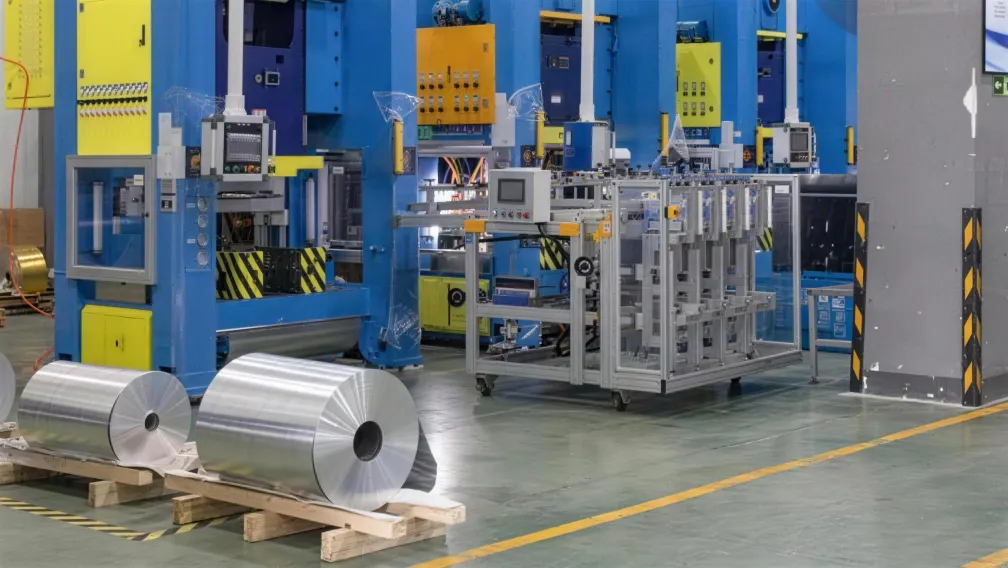
Evaluating the factory floor provides immediate insight into a supplier's scalability and dimensional consistency. Commercial food processing lines, particularly automated Modified Atmosphere Packaging (MAP) sealers, require trays with zero dimensional drift. If a tray's flange is stamped off-center by even a millimeter, the heat-sealing film will fail, causing gas leakage and spoiled ready-meals.
This consistency is achieved through CNC servo-driven feeders. The audit must confirm that the manufacturer uses closed-loop servo feeders to advance the aluminum web into the press with exact, sub-millimeter indexing. Coupled with this feeding mechanism is the press itself. High-volume B2B output relies on heavy-duty H-frame presses ranging from 45 to 110 tons. These massive machines eliminate physical deflection during the violent stamping stroke. When equipped with 4-cavity or 6-cavity compound dies, a single automated press line can output over 300 containers per minute. Verifying this high-tonnage infrastructure ensures the manufacturer can absorb peak-season European demand (such as the Christmas bakery surge) without suffering lead-time blowouts.
BRCGS Certification and Inline Optical Inspection
For any manufacturer supplying European supermarket networks, GFSI-recognized certifications are a mandatory baseline. The British Retail Consortium Global Standard (BRCGS) for Packaging Materials is the gold standard. Achieving an A or AA rating in a BRCGS audit proves that the manufacturer adheres to strict Hazard Analysis and Risk-Based Preventive Controls (HARPC). In a BRCGS-certified plant, the production floor operates under positive air pressure to prevent the ingress of unfiltered outside air and dust. Workers adhere to strict hygiene protocols, navigating through air showers and sanitization stations before entering the automated stamping zones.
Beyond paper certifications, the audit should evaluate the manufacturer's active Quality Assurance (QA) hardware. Relying solely on manual, randomized sampling is insufficient for runs of millions of units. Top-tier facilities deploy inline optical vision systems. High-speed cameras scan every single container as it is ejected from the press, instantly identifying micro-pinholes, incomplete flange curls, or foreign debris. Defective units are automatically blown off the conveyor line via pneumatic jets before they reach the stacking unit, guaranteeing a near-zero defect rate for the end user.
Raw Material Sourcing and EPR Scrap Loops
The final phase of the B2B audit involves supply chain resilience and environmental compliance. Global aluminum pricing is subject to London Metal Exchange (LME) volatility. An elite manufacturer maintains deep, contracted relationships with primary aluminum rolling mills, securing consistent allocations of raw coil, thereby insulating their B2B clients from sudden market shortages.
Additionally, European Extended Producer Responsibility (EPR) frameworks highly value the circular economy. The audit should observe how the manufacturer handles their internal industrial waste. The "skeletal web"—the scrap aluminum matrix remaining after the trays are blanked out—should be continuously extracted by motorized aspirators, compacted into dense briquettes by automated balers, and sold directly back to the rolling mills for remelting. This closed-loop scrap recovery heavily subsidizes the overall production cost and provides the carbon-reduction traceability increasingly demanded by EU Green Public Procurement (GPP) mandates.
Partnering for Long-Term Manufacturing Stability
Selecting an aluminum foil container manufacturer is a strategic operational decision. By rigorously auditing their EFSA compliance protocols, metallurgical expertise, in-house CNC tooling capabilities, and BRCGS quality systems, European procurement professionals can identify partners capable of delivering flawless, scalable, and legally compliant packaging solutions. A manufacturer that controls every variable—from alloy procurement to optical defect ejection—ultimately protects the structural integrity of your food products and the financial margins of your supply chain.
-

SEPACK
Aluminum Foil Packaging Manufacturer
SEPACK supplies aluminum foil containers, rolls, sheets, baking pans, and food wraps to distributors and foodservice businesses in 50+ countries. Headquartered in New York with manufacturing in Shanghai, operating since 2010.