

European aviation catering hubs and high-volume Quick Service Restaurants (QSRs) operate within punishing time constraints and strict thermodynamic requirements. In these industrial foodservice environments, packaging is an active component of the production line. The traditional method of tearing foil from a continuous roll introduces critical inefficiencies: variable material usage, two-handed operational bottlenecks, and inconsistent thermal wrapping. To resolve these friction points, procurement engineers specify pre-cut aluminum foil sheets. By integrating "pop-up" interleaved dispensing mechanisms, precise metallurgical dead-fold characteristics, and optimal infrared reflectivity, these standardized sheets drastically optimize assembly speed, portion control, and hot-hold temperature compliance across the European food supply chain.
The Mechanics of Interleaved Z-Fold Dispensing
The primary economic driver for transitioning to pre-cut foil sheets is operational ergonomics. In a high-throughput QSR kitchen assembling thousands of breakfast sandwiches or burgers per shift, fractions of a second matter. Standard foil rolls require an operator to use two hands—one to pull the foil and the other to shear it against a serrated metal edge. This repetitive motion not only slows down the assembly line but introduces risks of minor lacerations and uneven sheet sizes.
Pre-cut foil sheets resolve this through an engineered packaging format known as the "pop-up" dispenser. Inside the dispenser box, the sheets are folded in an overlapping Z-fold pattern (interleaved). When an assembly worker pulls the top sheet, the friction between the overlapping layers automatically draws the leading edge of the next sheet through the dispenser aperture, presenting it upright and ready to grab.
This allows for one-handed operation. A worker can hold the hot food item in their left hand while instantly pulling a perfectly sized foil sheet with their right. Time-motion studies in commercial kitchens demonstrate that eliminating the tear-and-measure phase saves approximately 2 to 3 seconds per wrap. When multiplied across millions of meals annually, this seemingly minor ergonomic improvement translates into hundreds of reduced labor hours and significantly faster customer service times.

Thermodynamics: Infrared Reflectivity and Hot-Hold Operations
Packaging in the QSR and aviation sectors must act as a temporary thermal insulator. Sandwiches, wraps, and airline meal components are frequently assembled, packed, and held in heated cabinets or ATLAS trolley systems before consumption. Preserving the core temperature above the strict 60°C Hazard Analysis Critical Control Point (HACCP) threshold is non-negotiable.
Aluminum operates differently than insulating materials like polystyrene or thick paperboard. Aluminum is highly reflective to infrared radiation (radiant heat). When a hot sandwich is wrapped in a bare aluminum foil sheet, the food mass emits infrared heat waves. The shiny surface of the foil reflects approximately 95% of this radiant heat directly back into the food, while only emitting (losing) about 5% to the surrounding environment.
This high reflectivity traps the thermal energy tightly against the product. Unlike porous paper wrappers that absorb steam, become saturated with grease, and rapidly lose heat through evaporation, aluminum forms an impermeable metallic barrier. It locks in latent heat, preventing the evaporation of moisture and ensuring that breads remain soft and proteins remain at safe serving temperatures during the crucial 30-to-60-minute holding period in a commercial warming bin.
Metallurgical Dead-Fold: Achieving a Semi-Hermetic Seal
A critical engineering property of aluminum foil is its "dead-fold" capability. Plastics, papers, and biodegradable films possess an elastic memory; when folded, the material naturally attempts to spring back to its original flat state. To secure a wrap using elastic materials, operators must apply adhesive stickers, complex folding techniques, or external ties.
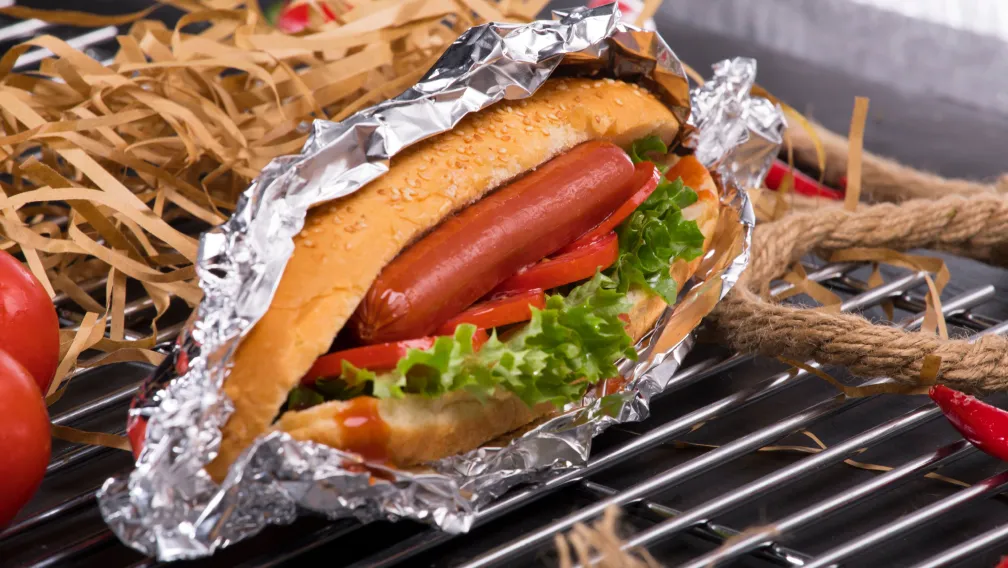
Pre-cut foil sheets, typically manufactured from soft-temper (O-temper) 8011 aluminum alloy with a gauge between 10 and 15 microns, exhibit zero elastic spring-back. When a kitchen worker wraps a sheet around a hot food item and crimps the edges, the metal undergoes plastic deformation. It holds the exact crease, molding perfectly to the irregular contours of a burger, burrito, or baked potato. This dead-fold characteristic creates an immediate, secure, and semi-hermetic vapor seal without requiring secondary adhesives. It prevents hot grease from leaking onto the customer's hands and prevents the intrusion of external cold air during delivery logistics.
Standardization and Aviation MTOW Optimization
In the aviation catering supply chain—serviced by mega-kitchens like LSG Sky Chefs or Gate Gourmet—weight and space are critical constraints. The aviation industry calculates logistics down to the gram, as excess mass directly increases jet fuel consumption.
When flight galley crews utilize continuous foil rolls to wrap oven inserts or separate meal components, the varying lengths of torn foil lead to unpredictable mass. Utilizing precision-cut aluminum foil sheets (such as standardized 9" x 10" or 12" x 10" formats) guarantees strict mass standardization. Every sheet weighs the exact same fraction of a gram. This eliminates material waste and ensures absolute predictability when calculating the Maximum Takeoff Weight (MTOW) of an aircraft's catering payload. By shaving unnecessary grams off thousands of meals per flight, airlines achieve measurable reductions in fuel burn and Scope 1 carbon emissions over their annual flight schedules.
PFAS-Free Compliance and the EU Green Deal
The European packaging sector is currently navigating severe legislative changes regarding chemical food-contact materials. To prevent grease from soaking through traditional paper sandwich wraps, manufacturers historically coated the paper with PFAS (Per- and polyfluoroalkyl substances). These "forever chemicals" are now facing sweeping bans across the EU due to their toxicity and inability to break down in the environment.
Aluminum foil sheets offer a completely inert, inherently grease-proof alternative. Bare aluminum requires zero chemical coatings to repel oil, water, or hot fats. It achieves total grease resistance solely through its dense metallic lattice. By transitioning from PFAS-coated paper wraps to aluminum foil sheets, European QSRs and institutional caterers ensure absolute compliance with tightening European Food Safety Authority (EFSA) migration limits.
EPR Eco-Taxes and Eddy Current Recovery
Furthermore, aluminum aligns perfectly with the Extended Producer Responsibility (EPR) tax frameworks enforced by EU member states. Multi-layer wraps (like poly-coated or wax-coated papers) are notoriously difficult to recycle, often incurring high end-of-life eco-taxes because they must be incinerated or landfilled.
Aluminum is a permanent material. When discarded aluminum foil sheets enter municipal Material Recovery Facilities (MRFs), they are efficiently ejected from the mixed waste stream by high-speed Eddy Current Separators (ECS). Recovered aluminum requires only 5% of the primary energy to be remelted into new products. Because it is highly valuable and easily recovered, pure aluminum packaging attracts significantly lower EPR taxation tiers compared to composite paper-plastic alternatives.
Specifying the Correct Sheet Dimensions for Your Kitchen
Integrating pre-cut foil sheets requires aligning the physical dimensions of the sheet with the specific menu items to avoid material waste. A 9" x 10" sheet provides the perfect economical footprint for standard breakfast sandwiches, hot dogs, and smaller baked goods. Conversely, a 12" x 10" or 12" x 12" sheet is required to fully envelope large burgers, massive burritos, or oversized baked potatoes without leaving exposed gaps.
By migrating from erratic foil rolls to precision-dispensed aluminum foil sheets, commercial operators eliminate the two-handed tearing bottleneck. They guarantee HACCP-compliant thermal retention via infrared reflectivity, eliminate PFAS compliance risks, and establish a highly predictable, standardized packaging workflow that protects both food quality and operational profit margins.
-

SEPACK
Aluminum Foil Packaging Manufacturer
SEPACK supplies aluminum foil containers, rolls, sheets, baking pans, and food wraps to distributors and foodservice businesses in 50+ countries. Headquartered in New York with manufacturing in Shanghai, operating since 2010.