

Every disposable aluminum foil container on the market belongs to one of two families. Wrinkle-wall containers carry the familiar ribbed sidewalls you see on takeout pans and catering trays. Smooth-wall containers have flat, seamless sides and a cleaner, more rigid feel. The difference is not cosmetic. It comes from how each type is formed, and it decides the container's strength, lid options, appearance, and unit cost. This guide breaks down the two types and gives you a clear way to choose between them.
How each type is made
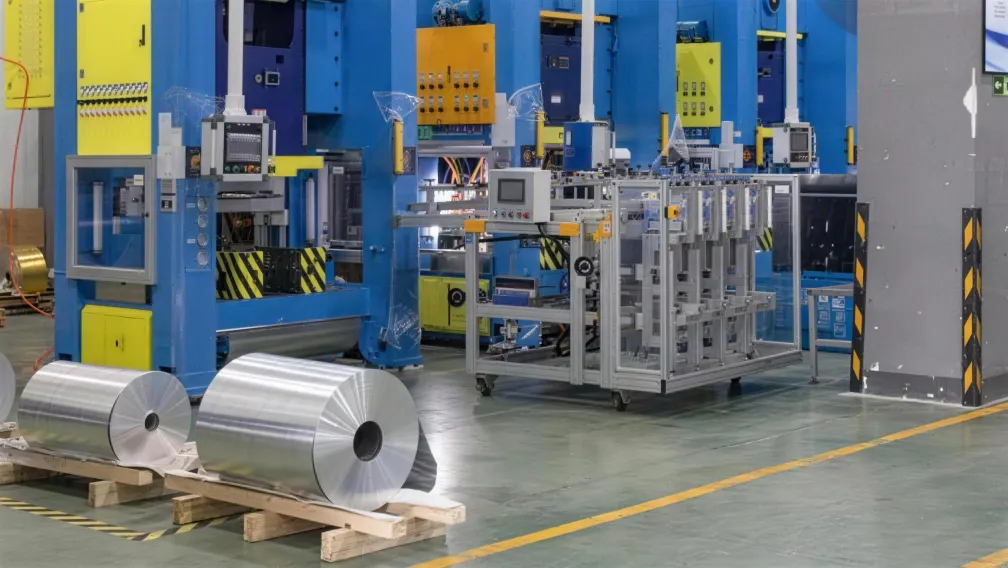
Both types start as aluminum coil and are formed in one press stroke, but the tooling behaves very differently. A wrinkle-wall die lets the foil pleat in a controlled pattern as the punch draws it into the cavity. Those pleats become the visible ridges on the sidewall. The process is forgiving: standard 8011 alloy in H22 or H24 temper forms cleanly at 40 to 90 microns, and the presses run fast, which is why wrinkle-wall containers dominate high-volume foodservice.
A smooth-wall die does the opposite. It stretches the foil uniformly across the wall so no pleats can form. That demands a softer material — typically 3003 or 8006 alloy in O temper — and a heavier gauge, usually 80 to 150 microns. The dies need tighter radii and controlled blank-holder force, and the line runs slower. The result is a container with an even wall thickness and a flat flange around the rim, which matters later when we talk about sealing.

Wrinkle wall vs smooth wall at a glance
| Wrinkle-Wall | Smooth-Wall | |
|---|---|---|
| Forming method | Single-stroke stamping with controlled pleating | Stretch drawing over precision dies |
| Typical alloy | 8011 (H22/H24 temper) | 3003 or 8006 (O temper) |
| Typical thickness | 40-90 microns | 80-150 microns |
| Strength source | Ridge geometry | Heavier gauge, seamless wall |
| Lid options | Foil crimp lids, board lids, plastic snap lids | Heat-seal film, PET dome lids, foil lids |
| Appearance | Functional, standard catering look | Premium, retail-ready finish |
| Unit cost | Lower | Higher (typically 20-50% more) |
| Typical uses | Takeout, delivery, catering, bakery | Ready meals, retail display, premium meal prep |
Strength and heat performance
Wrinkle-wall containers get their rigidity from geometry. The corrugated wall works like an I-beam in miniature, so a thin foil still stacks, carries, and holds shape under load. The ridges also trap thin pockets of air along the wall, which slows heat transfer. In practice, food in a wrinkle-wall pan stays hotter longer on the way to the customer. The trade-off is that the thin walls flex under point pressure and can dent if roughly handled.
Both types also move from freezer to oven without a transfer step, which is why they anchor meal-prep and frozen-meal programs. Freeze-thaw performance is the same for both families; the differences that matter are sealing and rigidity.
Smooth-wall containers rely on metal instead of geometry. The heavier gauge makes them noticeably more rigid and crush-resistant, and the even wall thickness conducts heat uniformly, which helps in oven reheating. Their uniform shape also stacks and denests cleanly — an advantage on automated filling lines where wrinkled walls can hang up. Both types handle conventional oven temperatures up to about 260°C (500°F), so oven safety is not a deciding factor between them.
Lids and sealing: where the real divide sits
For many buyers, sealing decides the question before anything else does. Wrinkle-wall containers close with crimped foil lids, board lids, or snap-on plastic lids. These closures work well for delivery and catering, but they are mechanical fits — convenient, quick, and not airtight.
Smooth-wall containers carry a wide, flat rim flange built for heat sealing. A film lid bonded to that flange gives an airtight closure that works with modified atmosphere packaging, extends shelf life, and survives retail distribution. This is why supermarket ready meals, airline catering, and sealed frozen meals almost always run on smooth-wall trays. If your product needs a hermetic seal or a retail shelf life measured in days rather than hours, smooth-wall is the practical choice.

Cost: when the premium pays for itself
Smooth-wall containers cost more for two reasons: they use more aluminum per unit, and they form more slowly. Depending on size and gauge, expect a 20-50% premium over a comparable wrinkle-wall container. Whether that premium makes sense depends on what the container does for your product.
There is also a freight angle. Smooth-wall trays use more aluminum per unit, so a container-load of them carries more material cost, but their uniform shape packs denser and denests faster on filling lines. For automated operations, that handling efficiency offsets part of the price gap.
It pays back when the container is part of the product presentation — retail ready meals, premium meal-prep subscriptions, branded catering — or when heat sealing is a hard requirement. A package that looks better on the shelf and seals tighter in transit supports a higher menu or retail price. It rarely pays back in high-volume takeout and delivery, where the container spends its life inside a bag and the lowest reliable unit cost wins.
How to choose, by application
- Takeout and delivery: wrinkle-wall. Low cost, good heat retention, fast to close with crimp or board lids.
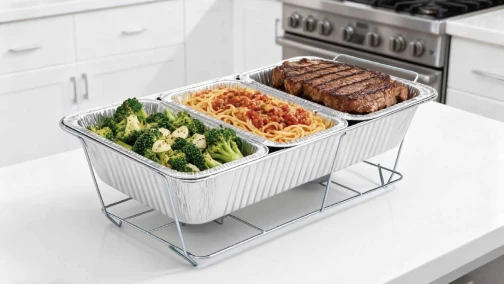
- Buffet and catering lines: wrinkle-wall steam table pans. Standard footprints, wide lid availability, economical at volume.
- Supermarket ready meals and airline meals: smooth-wall. Heat-seal film compatibility and shelf-ready appearance are the deciding factors.
- Premium meal prep and subscription food: smooth-wall where the brand is premium; wrinkle-wall where volume and cost lead.
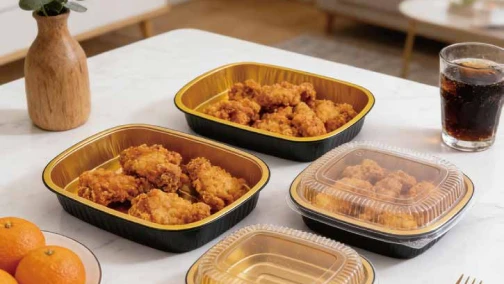
- Bakery and dessert display: smooth-wall or colored variants for window display; wrinkle-wall for back-of-house baking.
Many food businesses run both. A common pattern is wrinkle-wall containers for delivery orders and smooth-wall trays for retail or catering-display lines. Because both share the same material — food-grade aluminum — mixing the two adds no complication to storage, recycling, or oven use.
What to specify when you order
Whichever type you choose, a clear specification saves rounds of sampling. Four items cover most of it. First, capacity and dimensions — fill your actual portion and leave 10-15% headspace. Second, alloy and gauge — your supplier will match these to the forming process, but stating the application (oven reheating, freezing, heavy sauced dishes) helps them set the thickness. Third, rim and lid pairing — name the lid type you plan to use, since rim styles differ. Fourth, finish — smooth-wall containers accept color lacquer and embossing well, so branded or colored versions are practical at order quantities your supplier can quote.
As a manufacturer running both wrinkle-wall and smooth-wall production, we supply both families across standard and custom sizes, with color coating, embossing, and matched lid options. If you are weighing the two types for a specific product, send us the application and target volume — we will recommend the format and quote both options so you can compare on real numbers.
FAQs
What is the main difference between wrinkle-wall and smooth-wall foil containers?
The difference is in the forming. Wrinkle-wall containers are stamped so the foil pleats into ridges on the sidewall, giving strength through geometry at a low cost. Smooth-wall containers are stretch-drawn with no pleats, using thicker, softer alloy, which gives a rigid, premium container with a flat rim suited to heat sealing.
Are smooth-wall containers worth the higher cost?
They are when the package is part of the product's presentation or needs an airtight seal — retail ready meals, premium meal prep, airline catering. For everyday takeout and delivery, wrinkle-wall containers do the job at a lower unit cost.
Can both types go in the oven?
Yes. Both are food-grade aluminum and safe in conventional ovens up to about 260°C (500°F). Keep them away from direct flame and heating elements, and follow standard microwave guidance separately — foil containers are not microwave-safe by default.
Which type works with heat-seal film lids?
Smooth-wall containers. Their wide, flat rim flange is designed for heat-sealed film, including modified atmosphere packaging. Wrinkle-wall containers use crimped foil lids, board lids, or snap-on plastic lids instead.
Are wrinkle-wall and smooth-wall containers recyclable?
Both are single-material aluminum and fully recyclable. Rinsed containers can go into aluminum recycling streams wherever local programs accept foil packaging.
What thickness should I choose?
Wrinkle-wall containers typically run 40-90 microns and smooth-wall 80-150 microns. Match thickness to the load: light bakery items sit at the low end, heavy sauced dishes and oven-to-table service need the high end. Your supplier can confirm the gauge once they know the application.
Can I get colored or branded versions of both types?
Colored lacquer and embossed branding are most practical on smooth-wall containers, whose flat walls take coating and decoration cleanly. Colored wrinkle-wall options exist too, mainly for dessert cups and specialty shapes.
-

SEPACK
Aluminum Foil Packaging Manufacturer
SEPACK supplies aluminum foil containers, rolls, sheets, baking pans, and food wraps to distributors and foodservice businesses in 50+ countries. Headquartered in New York with manufacturing in Shanghai, operating since 2010.