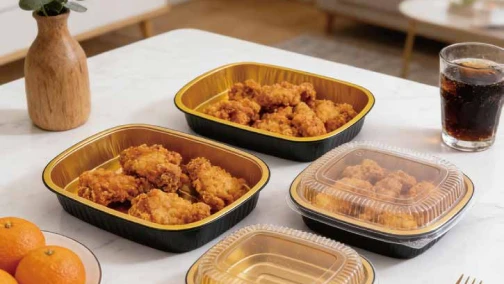


Buyers choosing food packaging ask us this constantly, and the honest answer has a catch worth understanding. Aluminum foil containers are recyclable, and aluminum is one of the most valuable materials in the recycling stream. The catch is food residue: a clean tray gets recycled, a greasy one usually does not. This guide covers what really gets recycled, why trays and thin foil are treated differently, what to do with a dirty pan, and how aluminum really compares to plastic — written from the production side, where recyclability is built into the spec.
Are aluminum foil containers recyclable?
Yes. A foil container is the same metal as a drink can, and aluminum is endlessly recyclable. It can be melted down and remade with no loss in quality, again and again, which is why about three-quarters of all the aluminum ever produced is still in use today. Recycling it uses roughly 90% less energy than making new aluminum from ore, and a recycled tray can be back on a shelf as new metal in about two months. For a disposable product, that is a strong end-of-life story.
The qualifier is that the container has to reach the recycler clean. Aluminum’s value only holds if the metal can be processed, and clean-up is where most foil ends up in the trash instead.
The catch: food residue
This is the single most important thing to know. Recyclers reject foil and trays coated in food or grease. Baked-on cheese, oily sauces, and stuck-on food contaminate the batch, and a load with too much contamination can be pulled from the line and sent to landfill. So the rule is simple: a tray goes in the recycling only if it is reasonably clean.
For a tray that held dry or lightly oily food, a quick rinse or wash is enough. For one with baked-on grease that will not come off, it goes in the trash. A quick test: if water beads up on the surface after rinsing, there is still oil on it. Many rigid foil pans can go through the dishwasher, which makes cleaning them for recycling — or for another use — easy.
Rigid trays vs thin foil
Foil pans and thin foil sheets are not treated the same at the facility. Rigid trays — pie pans, takeout containers, baking pans — are accepted more widely, because they are heavier, hold their shape, and rinse clean easily. Thin foil sheets are harder. They are light enough to blow around and jam sorting equipment, and they trap more food in their creases, so some programs turn them away.
If you are recycling loose foil, ball it up into a piece at least two to three inches across so the machinery can catch it. And there is an easy way to tell foil from the plastic film it often gets confused with: the scrunch test. Scrunch it in your hand — aluminum stays crumpled, plastic film springs back.
What does not get recycled
Some foil-based packaging cannot be recycled at all, and it helps to know the difference. Anything that bonds foil to plastic or paper — chip bags, coffee bags, yogurt lids, juice cartons, foil-lined pouches — is a composite. Current recycling cannot separate the layers, so these go in the trash. Pure aluminum trays and clean foil are recyclable; multi-material packaging that happens to contain foil is not. One more note: bottle-deposit laws cover aluminum cans, not foil, so trays do not earn a deposit refund.
Aluminum vs plastic: the honest comparison
It is tempting to say aluminum always beats plastic, but the real picture is more useful to a buyer. Aluminum’s advantage is the recycling loop, not the raw-material footprint. Making new aluminum from ore is energy-intensive, and on production emissions alone, some lifecycle studies put plastic lower. Where aluminum pulls ahead is what happens after use: it is recovered at far higher rates, it already carries a high share of recycled content, it recycles forever without degrading, and it sheds no microplastics into food or oceans.
| Factor | Aluminum foil tray | Plastic container |
|---|---|---|
| Recyclability | Endless, no quality loss | Degrades each cycle |
| Recycling rate | High; most aluminum stays in use | Low; small fraction ever recycled |
| Recycled content | High in aluminum stock | Low |
| Microplastics | None | Sheds microplastics |
| Oven & freezer | Both | Limited |
| Virgin production energy | High | Lower |
Plastic is recycled at very low rates — only a small fraction of all plastic ever made has been recycled — and it loses quality each time it is reprocessed. For packaging that re-enters the loop, aluminum’s closed cycle is the stronger case. The lever for a brand is to buy trays with recycled content and design them to be recyclable.
Reuse before you recycle
A rigid foil tray often has a few lives in it before recycling. If it is not dented or torn, wash it — by hand or in the dishwasher — and use it again for storage, baking, or organizing. Each reuse delays the recycling step and stretches the value of the metal. When a tray is finally too worn, it goes in the bin, clean.
For food brands: building recyclability into the pack
From the manufacturing side, recyclability is a design choice, not just a line on the label. If your packaging needs to recycle cleanly, a few things matter: keep it single-material aluminum rather than a foil-plastic laminate; choose a tray that releases food cleanly so the customer can rinse it; favor rigid trays over thin film for higher acceptance; and source stock with recycled content to lower the footprint from the start. We build food-grade foil packaging to those principles, so a brand’s recyclable-packaging claim holds up at the curb, not just on the box.
Sourcing recyclable food packaging? We manufacture food-grade aluminum foil containers — trays, lidded packs, and use-case pans — in single-material aluminum that recycles cleanly, with FDA, BRC, ISO and SGS certification and OEM and private-label options. Tell us your product and volume, and we will spec recyclable packaging and send samples.
FAQ
Are aluminum foil trays and takeout containers recyclable?
Yes, as long as they are reasonably clean. Rigid foil trays, pie pans, and takeout containers are widely accepted because they are easy to rinse and hold their shape. Rinse off food, and check that your local program lists aluminum.
Do you have to clean aluminum foil before recycling it?
Yes. Food residue and grease contaminate the batch, and heavily soiled foil is sent to landfill. A quick rinse or wipe handles light soiling; baked-on grease that will not come off means the trash.
Is greasy or food-soiled aluminum foil recyclable?
No. Once foil is coated with grease or baked-on food that will not wash off, recyclers reject it because it contaminates the load. Clean it well or bin it.
Can you put aluminum foil in curbside recycling?
It depends on your program. Many accept clean, balled-up foil and rigid trays; some reject thin foil over contamination and sorting issues. Confirm with your local hauler, and ball loose foil to at least two to three inches.
Can aluminum foil be recycled indefinitely?
Yes. Aluminum does not degrade when recycled, so the same metal can be remade into new products endlessly. About three-quarters of all aluminum ever produced is still in use, and recycling it uses far less energy than making it new.
Is aluminum better than plastic for the environment?
For packaging that re-enters the recycling loop, generally yes — aluminum is recovered at higher rates, recycles forever without quality loss, and sheds no microplastics. Making new aluminum is energy-intensive, so the benefit comes from recycled content and high recovery.
-

SEPACK
Aluminum Foil Packaging Manufacturer
SEPACK supplies aluminum foil containers, rolls, sheets, baking pans, and food wraps to distributors and foodservice businesses in 50+ countries. Headquartered in New York with manufacturing in Shanghai, operating since 2010.