

Commercial catering across the European Union operates on a foundation of strict modular standardization. Unlike consumer kitchenware, industrial food service relies entirely on equipment interchangeability—from preparation counters and blast freezers to insulated transport carriers and buffet chafing racks. At the epicenter of this logistical framework is the Gastronorm (GN) sizing system, formally defined under the EN 631 standard. To achieve both operational efficiency and cold-chain compliance, procurement engineers must source foil pan sizes that perfectly replicate these exact stainless steel dimensions while delivering the economic benefits of single-use packaging.
The Mechanics of the Gastronorm (GN) Ecosystem
The Gastronorm system is built upon a fundamental base measurement known as GN 1/1, which dictates an exact outer dimension of 530 mm in length by 325 mm in width. Every oven rail, speed rack, and steam table water pan in a professional European kitchen is calibrated to accept this footprint. From this base, fractional foil pan sizes are derived to allow modular combinations within a single holding rack.
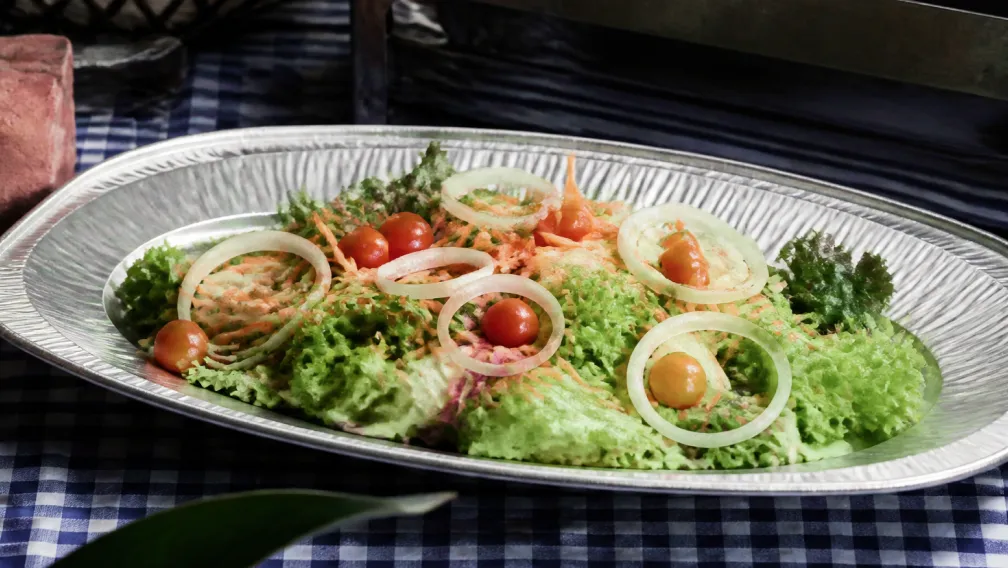
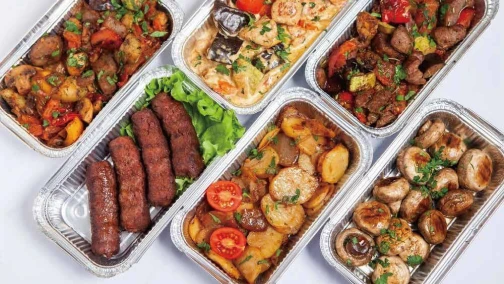
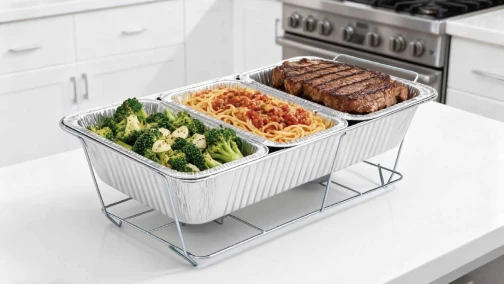
For example, a GN 1/2 pan measures 325 mm by 265 mm. A catering operator can place exactly two GN 1/2 pans side-by-side into a single GN 1/1 chafing dish frame. This modularity allows a central kitchen to partition a single heat source, simultaneously serving a heavy protein in one half-size pan and a starch or vegetable in the adjacent half-size pan. Other common fractional sizes include GN 1/3 (325 x 176 mm) and GN 1/4 (265 x 162 mm), utilized extensively in salad bars and hot topping stations.
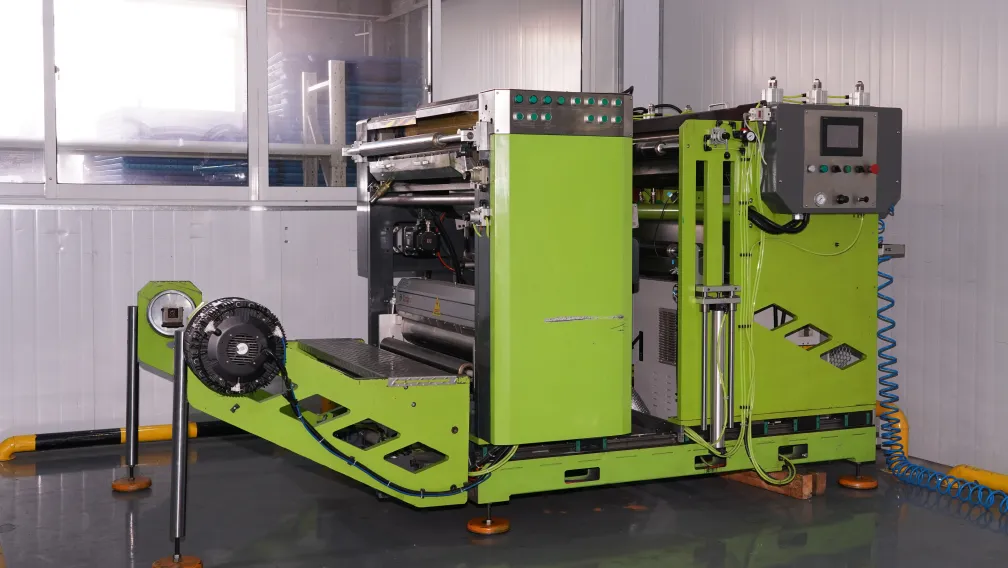
Stamping single-use aluminum foil to these exact specifications requires zero-tolerance die engineering. If the flange (outer rim) of a foil pan is stamped a few millimeters too wide, it will jam against the stainless steel rails of the holding cabinet. Conversely, if the flange is too narrow, the pan will lack the necessary surface overlap and collapse directly into the 90°C boiling water bath below. Manufacturers must calculate the exact metallurgical "spring-back" of the 3003 or 8011 aluminum alloy during the deep-draw press stroke to ensure the final outer dimensions conform flawlessly to the EN 631 standard.
Structural Integrity: Full Curl Rims and Deep-Draw Geometry
Standardized footprint dimensions mean nothing if the vessel cannot support the corresponding volumetric weight. A deep GN 1/1 full-size steam table pan (typically reaching 65mm or 80mm in depth) can hold up to 8 to 10 liters of food. When loaded with dense items like lasagna, mashed potatoes, or braised meats, the physical payload routinely exceeds 8 kilograms.
Supporting this mass utilizing a metal substrate that is only 0.10mm to 0.15mm thick represents a significant mechanical engineering challenge. The solution lies in two specific structural interventions during the stamping process: wrinkle-wall corrugations and the Full Curl (FC) rim.
First, as the press punch drives the aluminum coil into the die cavity to create a deep-drawn GN pan, the excess metal gathers into precise, corrugated ridges along the vertical sidewalls. In civil engineering terms, these wrinkles act as load-bearing columns. They drastically increase the vertical compression strength of the thin metal web, transferring the downward gravitational pull of the food directly to the base of the pan and preventing the sidewalls from buckling.
Second, and most critically, the raw outer edge of the aluminum is mechanically rolled into a continuous tubular hoop—the Full Curl rim. This geometric feature provides immense torsional rigidity. When a catering professional lifts a fully loaded GN 1/1 foil pan out of a transport box by its narrow edges, it is the Full Curl rim that absorbs the torque, preventing the aluminum tray from folding in half and causing a catastrophic spill.
Thermodynamics in Chafing Dishes and HACCP Compliance
The primary function of a steam table pan is to hold cooked food at safe serving temperatures over an extended buffet service. This is achieved by suspending the food pan over a heated water bath. Consequently, the thermodynamic properties of the packaging material directly impact food safety and regulatory compliance.
European food safety agencies enforce strict Hazard Analysis Critical Control Point (HACCP) regulations, which mandate that hot food must be held continuously above 60°C to 65°C to prevent the proliferation of dangerous pathogens. Aluminum possesses a remarkably high thermal conductivity rating of approximately 235 W/(m·K). When a Gastronorm aluminum foil pan makes contact with the steam rising from the chafing dish water bath, the thermal energy transfers almost instantaneously through the metal base and directly into the food mass.
This rapid conductive transfer ensures the core temperature of the food remains safely within the HACCP compliance zone. By contrast, replacing metal with insulating materials—such as heavy CPET plastics or thick ceramics—creates a thermal barrier. These materials block the heat of the water bath from penetrating efficiently, leading to dangerous temperature drop-offs and cold spots where bacterial growth can accelerate.
Lidding Systems and Cold-Chain Transport Security
A GN foil pan must operate as both a cooking vessel and a secure transport container. Moving liquid-heavy dishes from a central kitchen across a city in a delivery truck demands a reliable, spill-proof lidding system.
For bulk institutional transport, catering operations rely on rigid foil-laminated board lids. The foil board is placed flat over the opening of the GN pan. Using a manual tool or an automated crimping machine, the operator folds the vertical edge of the Full Curl rim downwards, crimping it tightly over the board. This mechanical crimp creates a semi-hermetic, highly secure seal. It locks in moisture and latent heat, preventing sauces from splashing during vehicular transit. Furthermore, the completely flat profile of the crimped lid allows catering staff to safely stack multiple heavy GN 1/1 or GN 1/2 pans directly on top of each other inside insulated Cambro-style food carriers, maximizing the cubic capacity of the delivery vehicle.

The Financial ROI of Eliminating Reverse Logistics
The transition from traditional stainless steel GN pans to heavy-duty single-use aluminum foil pan sizes is fundamentally driven by B2B operational economics. A standard stainless steel GN 1/1 pan is a heavy capital expenditure, often costing between €15 and €30 per unit. When a caterer dispatches 100 of these pans to a corporate event, they incur massive hidden logistical costs.
The most severe drain on profitability is reverse logistics. To reclaim the stainless steel assets, the catering company must dispatch a driver and vehicle back to the venue the following day. Upon return to the central kitchen, the pans must be processed through industrial dishwashers. The blended cost of this return trip, labor hours for scraping and washing, hot water energy, and chemical detergents routinely exceeds €2.00 to €3.00 per pan. Furthermore, a predictable percentage of these expensive steel pans are lost, accidentally discarded by venue staff, or stolen, requiring constant capital reinvestment.
Deploying Gastronorm-sized aluminum foil pans executes a "drop-and-go" delivery model. The food is cooked, transported, and served in the same vessel. After the event, the client simply recycles the aluminum on-site. The catering company eliminates the return transport leg, zeroes out dishwashing labor, and prevents asset shrinkage. The upfront unit cost of the foil pan is negligible compared to the total elimination of the reverse logistics overhead, allowing the caterer to aggressively scale their event capacity without being constrained by a limited inventory of clean steel pans.
EPR Taxation and the Circular Economy of Aluminum
In the heavily regulated European market, packaging procurement cannot ignore end-of-life disposal costs. The Extended Producer Responsibility (EPR) framework levies eco-taxes on food producers based on the recyclability of their packaging waste. Multi-layer plastics and black CPET trays are heavily penalized due to their low recovery rates in municipal Material Recovery Facilities (MRFs).
Aluminum holds a unique position as a permanent material that degrades zero percent during the recycling process. Because commercial Gastronorm foil pans represent a large, dense mass of high-value metal, they are easily and profitably captured by Eddy Current Separators (ECS) in automated waste sorting lines. Melting post-consumer aluminum requires only 5% of the energy necessary for primary bauxite smelting. Consequently, European environmental authorities assign aluminum to the lowest EPR taxation tiers. By specifying precise foil pan sizes manufactured from 100% recyclable aluminum alloys, large-scale catering operations not only streamline their kitchen logistics but significantly reduce their annual eco-tax liabilities.
-

SEPACK
Aluminum Foil Packaging Manufacturer
SEPACK supplies aluminum foil containers, rolls, sheets, baking pans, and food wraps to distributors and foodservice businesses in 50+ countries. Headquartered in New York with manufacturing in Shanghai, operating since 2010.