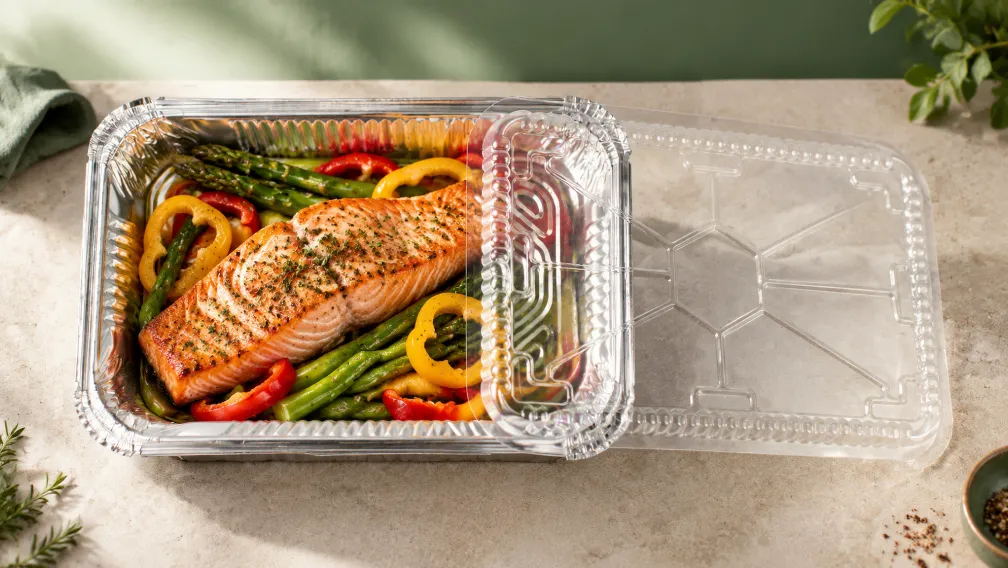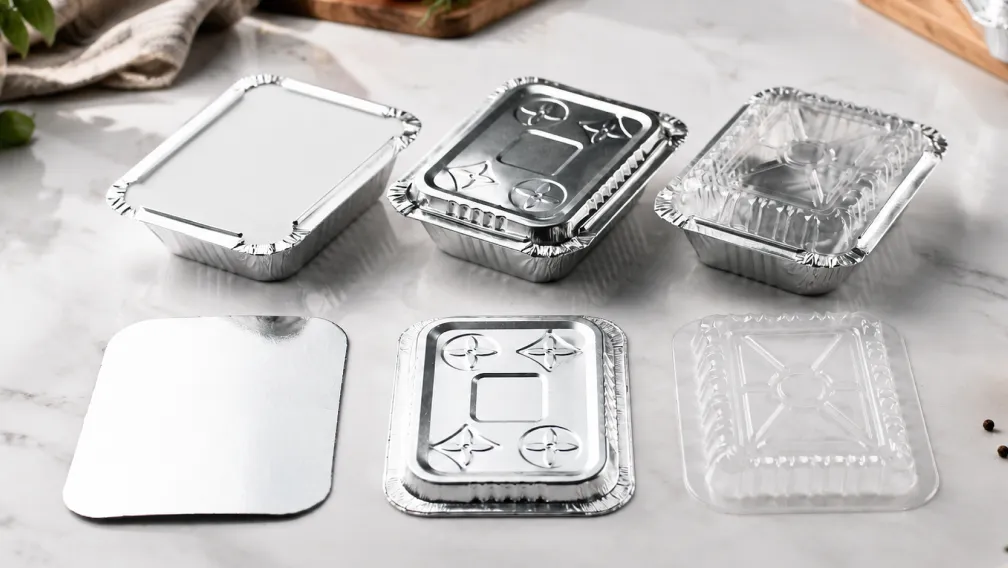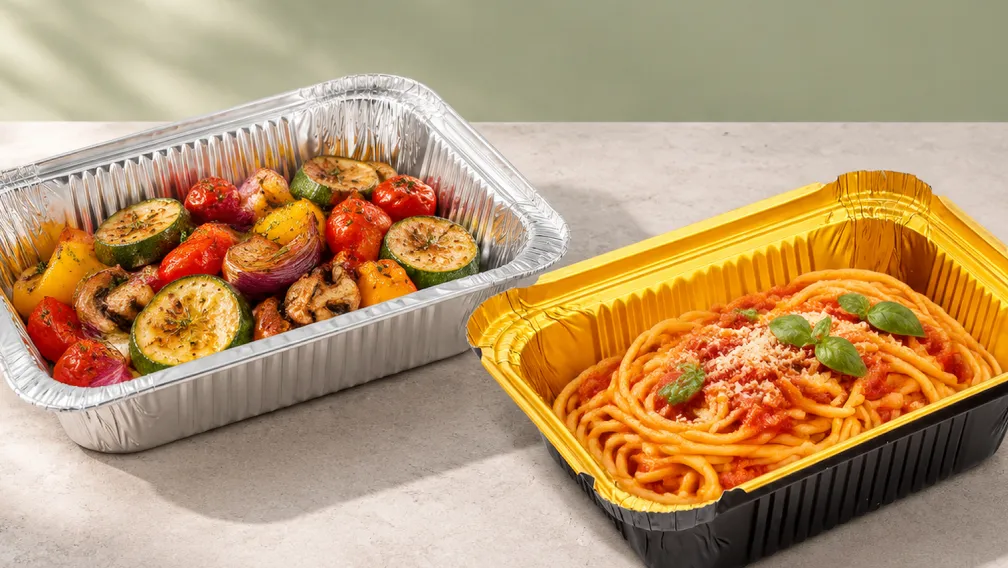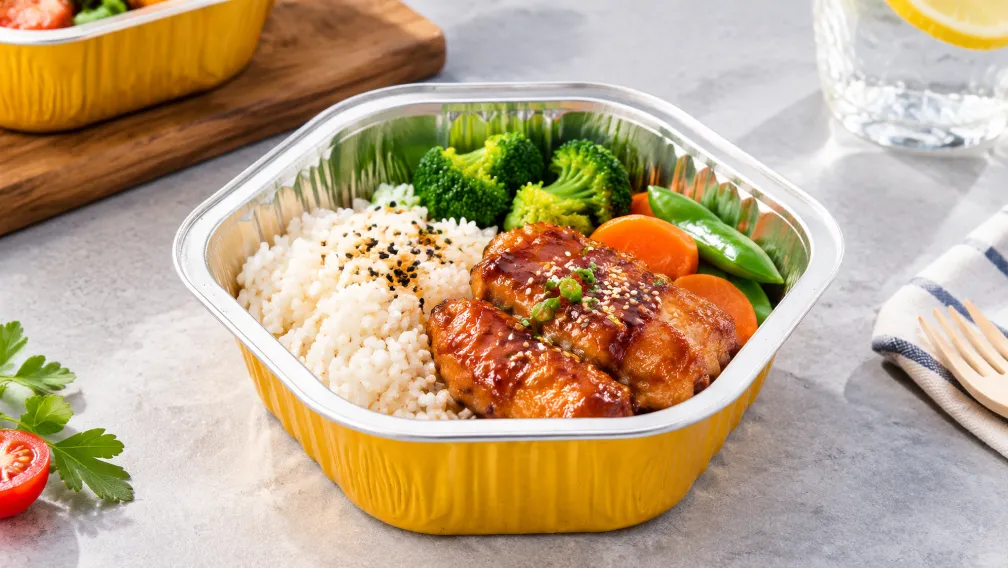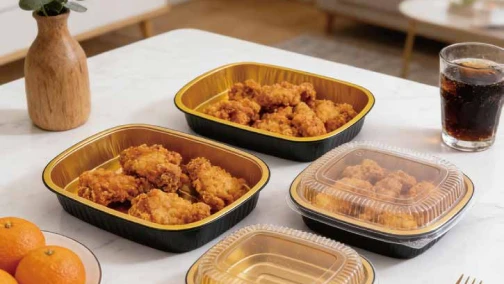


A foil container starts as a flat roll of aluminum and ends as a rigid tray in about two seconds. Between those two points sits a short, tightly controlled production line: decoil, lubricate, feed, press, stack, pack. There is no welding, no gluing, and no assembly — the container's entire shape, including its rolled rim and reinforcing ribs, comes out of a single press stroke. This is the process as it runs on our lines, from the alloy decision to the case that ships.
It starts with the alloy, not the machine
Container production uses food-grade aluminum coil, typically between 0.03 and 0.2 mm thick. Three alloys do nearly all the work, and choosing between them is the first engineering decision of any order:
| Alloy | Typical thickness | Key properties | Common use |
|---|---|---|---|
| 8011 | 0.03 – 0.2 mm | Easy stamping, strong moisture barrier, resists cracking | Standard takeaway trays, general food containers |
| 3003 | 0.06 – 0.2 mm | Higher tensile strength, holds shape under load | Multi-compartment trays, deeper or complex shapes |
| 8006 | 0.03 – 0.15 mm | Highest elongation and cupping value | Airline meal boxes, premium smooth-wall containers |
Two qualifications matter here. First, temper — the hardness state of the foil — shifts performance as much as the alloy itself; 8011 in a hard temper can out-strength 3003 in a soft one, so comparisons only make sense at equal temper. Second, every coil lot is verified before it enters the line: gauge tolerance, surface condition, and food-contact compliance. A coil that fails inspection never reaches the press, because a container line running at speed cannot compensate for bad stock.
From coil to press: decoil, lubricate, feed
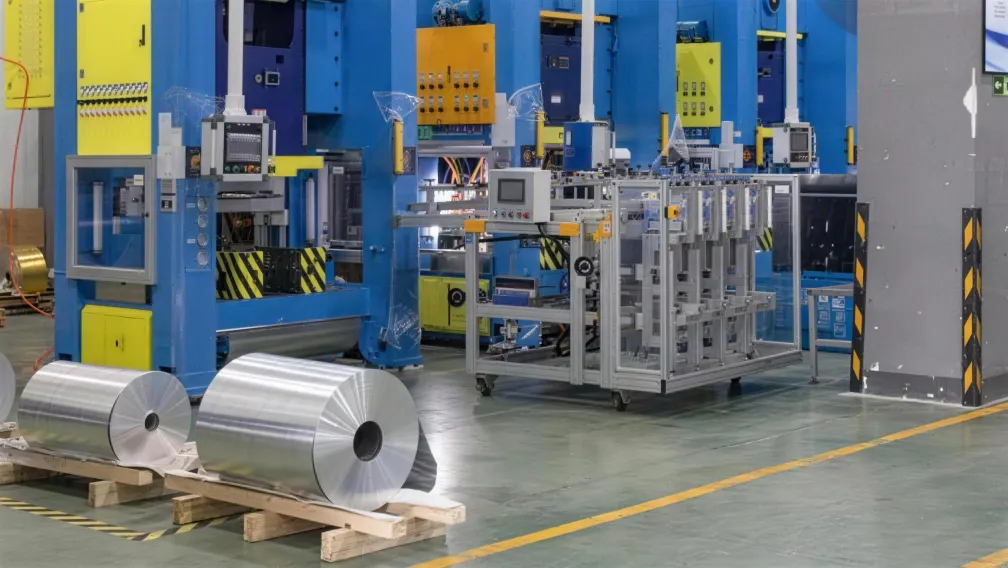
A production run starts by mounting the coil — commonly several hundred kilograms of foil, up to a meter wide — on a decoiler that unwinds it under constant tension. Tension control is not cosmetic. Foil that runs slack wrinkles before it reaches the die, and wrinkled stock becomes a misformed container.
Next comes lubrication. A thin film of food-grade forming oil — on the order of 300 to 400 mg per square meter, invisible and odorless — is sprayed onto the foil. Without it, the aluminum would gall against the die surface, tearing sidewalls and leaving scores on the tooling. The lubricant is certified for food contact and is part of the compliance file, not an afterthought.
A servo feeder then advances the foil into the press in exact steps matched to the container's pitch. The feeder clamps the web during each stroke so the foil cannot slip mid-form; positional accuracy at this stage is what keeps wall thickness and rim dimensions consistent across a million-unit run.
One press stroke does the forming
The press is the heart of the line, and the striking fact about it is how much happens in a single stroke — typically one to two seconds, at 30 to 80 cycles per minute depending on container size. When the ram comes down, the die set performs four operations at once:
- Drawing. The punch forces the foil into the die cavity, stretching it into the container's walls, base and bottom profile.
- Trimming. Cutting edges built into the die shear the formed container free from the surrounding web in the same motion.
- Curling. A curling ring rolls the cut edge into the smooth rim — the full curl that gives the tray its rigidity and safe handling edge.
- Embossing. Base patterns, brand marks and reinforcing ribs are pressed in during the same stroke.
When the ram lifts, spring ejectors pop the finished container clear and it air-conveys to the stacking unit. Output on a well-run line lands between 10,000 and 60,000 containers per day per machine, which is why foil packaging scales so well: the tooling is expensive once, and the per-unit cost after that is mostly metal.

Wrinkle-wall or smooth-wall is a mold engineering question
The wrinkles on a standard takeaway tray are not a finishing choice — they are the natural result of drawing metal into a die. As the foil flows into the cavity, the sidewall material gathers into fine corrugations, and those corrugations work like the folds in corrugated board: they add vertical rigidity for free. That is why wrinkle-wall containers dominate high-volume, price-sensitive programs.
A smooth wall asks the die to do something harder: stretch the metal uniformly so it neither wrinkles nor tears. That requires more complex die engineering, tighter control of draw ratios, and typically a higher-elongation alloy such as 8006 in O temper or 3003 in H24. The payoff is a container with a clean presentation surface and a rim that heat-seals — which is why smooth-wall containers carry airline meals and premium retail lines. Neither is better in absolute terms; they are two answers to two different briefs, and the die room decides which one a product gets.

Where the scrap goes
Stamping a shape out of a flat web leaves a skeleton of leftover foil, and on a container line that skeleton is a revenue stream, not waste. Automated collectors pull the scrap web away after every stroke, bale it, and return it to the aluminum supply stream. The economics are favorable because recycled aluminum takes roughly 5% of the energy of primary production — the reason about 75% of all aluminum ever produced is still in circulation. The same logic applies after the consumer is done with the tray, a cycle we cover in detail in our guide to foil container recycling.
Inspection and the paper trail
Formed containers pass automated vision inspection that checks each unit for pinholes, rim defects and dimensional drift, rejecting failures before the stacker. Behind the machines sits the compliance layer buyers actually audit: food-contact testing to FDA 21 CFR and EU Regulation (EC) No 1935/2004, BRCGS and ISO 9001 for the factory management system, and BSCI for social compliance. The lubricant, the alloy certificates and the migration test reports all live in the same technical file. For what those standards mean at the food-contact level, our evidence review on foil container safety walks through the regulator data.
What the process means for a buyer
Understanding the line clarifies three purchasing realities. First, shape is a tooling decision: a new size or a custom emboss means a new die, so manufacturers with large existing mold libraries — ours runs past 3,000 validated molds — can often match a requirement without new tooling cost or lead time. Second, MOQ and lead time follow the economics of the press: once a die is mounted, the line wants volume, which is why case quantities price so differently from retail packs. Third, customization beyond shape — colored lacquer, printed lids, private-label sleeves — bolts onto the same line rather than requiring a different product.
Specifying containers for a product line? We manufacture the full range of aluminum foil containers in food-grade 8011, 3003 and 8006 alloys, with 3,000+ validated molds, custom colors and private-label packaging. Tell us the application, target size and monthly volume, and we will check the mold library, spec the alloy and send samples.
FAQ
What alloy are aluminum foil containers made from?
Mostly food-grade 8011, 3003 or 8006 coil between 0.03 and 0.2 mm thick. 8011 suits standard takeaway trays, 3003 handles deeper and multi-compartment shapes, and 8006's high elongation serves premium smooth-wall and airline containers. Temper matters as much as alloy, so specs should name both.
How is a foil container formed?
In a single press stroke of one to two seconds. The die draws the foil into shape, trims the excess web, curls the rim and embosses any base pattern simultaneously. Lines run 30 to 80 strokes per minute, producing roughly 10,000 to 60,000 containers per machine per day.
Why do some foil trays have wrinkled walls?
The wrinkles form naturally as the metal draws into the die, and they add rigidity the way corrugation stiffens cardboard. Wrinkle-wall trays are the economical high-volume format. Smooth-wall trays need more complex dies and higher-elongation alloys to stretch the metal without wrinkling or tearing.
Is the oil used in forming safe for food contact?
Yes. The forming lubricant is a certified food-grade oil applied at around 300 to 400 mg per square meter — a film too thin to see. It prevents the foil from galling against the die and is documented in the product's food-contact compliance file.
What happens to the leftover foil from stamping?
It is collected automatically after every stroke, baled and returned to the aluminum supply chain. Recycling aluminum takes about 5% of the energy of primary production, so stamping scrap is a recovered resource rather than waste.
Can a manufacturer make a custom container shape?
Yes, but shape is tooling: a new size or emboss requires a dedicated die, which adds cost and lead time. Manufacturers with large mold libraries can often match a requirement from existing tooling. Beyond shape, colored lacquers, printed lids and private-label packaging customize the product without a new die.
-

SEPACK
Aluminum Foil Packaging Manufacturer
SEPACK supplies aluminum foil containers, rolls, sheets, baking pans, and food wraps to distributors and foodservice businesses in 50+ countries. Headquartered in New York with manufacturing in Shanghai, operating since 2010.