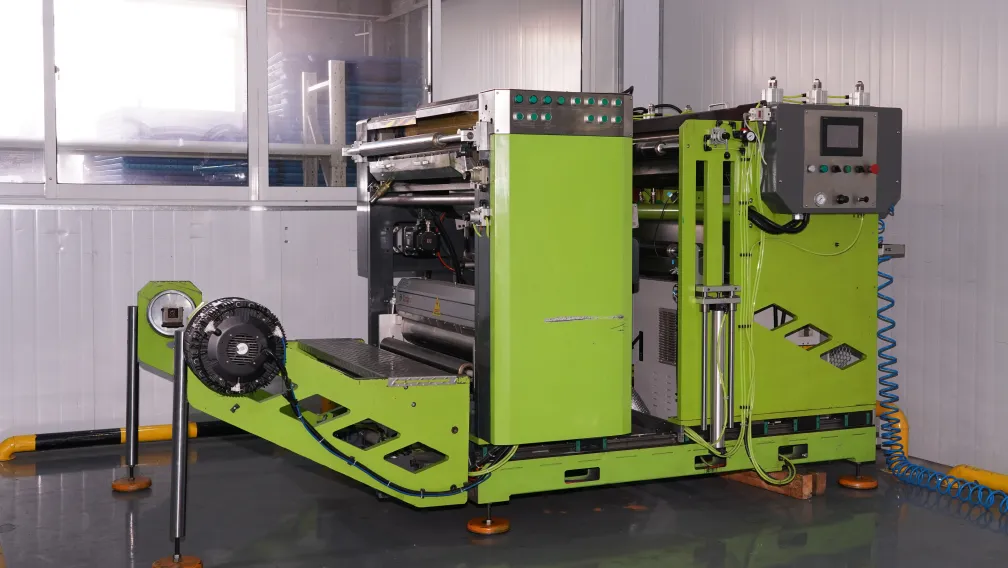


In the global food packaging supply chain, the structural reliability of a foil tray is entirely dictated by the precision of the manufacturing equipment that formed it. Producing millions of defect-free commercial containers per shift requires extreme mechanical tolerances, advanced pneumatic control, and dynamic alloy lubrication. The core of this industrial output is the aluminium foil container making machine. For B2B procurement officers, quality assurance managers, and food factory engineers, understanding the internal mechanics of this machinery provides critical insight into supplier capabilities, product dimensional consistency, and supply chain scalability.

Precision Decoiling and CNC Servo Feeding
The manufacturing cycle begins with raw material handling. Food-grade aluminum coil—typically 3003 or 8011 alloy in varying tempers, weighing up to 1,000 kilograms—is mounted onto a motorized decoiler. The decoiler unspools the web of metal under continuous, active tension. Maintaining exact tension is paramount; if the foil runs slack, it will wrinkle before entering the press, resulting in catastrophic structural defects in the final container.
The aluminum web is then drawn into a CNC (Computer Numerical Control) servo feeder. This feeder is the metronome of the entire production line. It advances the metal into the press die in exact, sub-millimeter increments corresponding to the precise pitch of the container mold. If the servo feeder drifts by even 0.1mm, the punch will stamp the container off-center. This results in uneven flanges (the outer rim), an imperceptible defect that will ultimately cause massive hermetic sealing failures when the container reaches an automated food packaging line. Premium machines utilize closed-loop servo drives to ensure absolute indexing repeatability across millions of cycles.
High-Tonnage Press Mechanics and Multi-Cavity Dies
The operational heart of the aluminium foil container making machine is the high-tonnage mechanical or pneumatic press. Commercial container production typically requires presses rated between 45 tons and 110 tons of force. Built on massive cast-iron H-frames or heavily reinforced C-frames, these presses are engineered to eliminate physical deflection (bending of the machine frame) during the violent downward stroke.
Modern production is executed via multi-cavity tooling. Instead of stamping one tray at a time, a high-volume press drives a compound die containing two, four, or even six individual cavities simultaneously. Operating at speeds of 40 to 80 strokes per minute (SPM), a single 4-cavity machine can output over 300 containers every sixty seconds.
During the split-second downward stroke of the ram, the tooling performs four simultaneous operations: blanking, drawing, curling, and embossing. First, the outer cutting ring shears the exact blank from the aluminum web. Instantly, the inner punch drives the blank down into the female die cavity, stretching the metal into the deep-drawn shape of a steam pan, pie plate, or takeaway container. At the absolute bottom of the stroke, the die embosses the base pattern (which adds structural rigidity) while the curling ring rolls the raw sheared edge underneath itself, forming the robust Full Curl (FC) rim.
Die Clearance: Wrinkle-Wall vs. Smooth-Wall Stamping
The most critical engineering variable inside the machine is the die clearance—the microscopic gap between the descending punch and the stationary die wall. This gap dictates the entire physical classification of the container.
For standard wrinkle-wall containers used in baking and takeaway, the die clearance is engineered to allow the excess aluminum to gather and fold uniformly as it is drawn into the cavity. These controlled wrinkles act as vertical load-bearing columns, providing high vertical compression strength for heavy food payloads.
Conversely, smooth-wall containers (utilized for high-end ready meals and Modified Atmosphere Packaging) require a fundamentally different metallurgical approach. The machine must exert massive blank-holding force, and the die clearance is machined to exact micron-level tolerances. The press literally "irons" the metal flat as it draws, stretching the highly ductile 8006 alloy without allowing a single wrinkle to form. Producing smooth-wall containers demands an exceptionally rigid press and flawless tooling to prevent the metal from tearing or "necking" (dangerous thinning of the sidewalls).
Dynamic Lubrication and EFSA Food-Contact Compliance
Drawing metal against hardened steel tooling generates immense friction. If an aluminium foil container making machine attempted to stamp bare, dry aluminum, the resulting heat and friction would instantly cause galvanic galling, destroying the die surface and tearing the container to shreds.
To prevent this, the machine features an automated, dynamic lubrication system. Just before the foil enters the press, micro-dosing sprayers apply a highly refined layer of stamping oil across the metal web. This lubricant must perform a dual role: it must withstand the immense pressure of the drawing stroke to ensure clean mold release, and it must comply strictly with FDA and EFSA (European Food Safety Authority) regulations for food-contact materials. Premium B2B manufacturers utilize certified food-grade, highly volatile mineral oils applied at microscopic levels (often less than 300 mg per square meter), ensuring the final packaging poses zero biochemical risk to the consumer.
Automated Stacking and Closed-Loop Scrap Recovery
As the press ram retracts, pneumatic air jets blast the finished containers out of the die cavities, ejecting them onto automated conveyor lanes. These lanes feed directly into high-speed stackers that count and nest the containers into precise sleeves, ready for bulk B2B boxing. This touchless automation ensures absolute hygiene, completely eliminating human contact with the food-grade surfaces.
Simultaneously, the machine manages its own industrial waste. The skeletal web—the continuous matrix of aluminum scrap left over after the containers are blanked out—is continuously pulled away by a motorized scrap aspirator. The scrap is fed into an automated baler or chopper, compressed into dense briquettes, and returned directly to the aluminum rolling mills. Because aluminum is a permanent material, this closed-loop recovery process allows the scrap to be remelted and rolled into new coil stock using only 5% of the energy required for primary extraction, heavily subsidizing the unit cost of the final product.
Why Machine Capabilities Dictate B2B Procurement Success
For procurement directors at commercial bakeries, institutional caterers, and food processing plants, the quality of your packaging is inseparable from the quality of the machinery that forged it. A supplier running outdated, low-tonnage equipment will inevitably deliver containers with inconsistent flanges, resulting in catastrophic jams on your automated filling lines and compromised hermetic seals.
Partnering with a manufacturer that commands a fleet of modern, servo-driven aluminium foil container making machines guarantees microscopic dimensional consistency, flawless curling geometry, and the massive throughput capacity required to scale alongside your most demanding peak-season food production runs.
-

SEPACK
Aluminum Foil Packaging Manufacturer
SEPACK supplies aluminum foil containers, rolls, sheets, baking pans, and food wraps to distributors and foodservice businesses in 50+ countries. Headquartered in New York with manufacturing in Shanghai, operating since 2010.