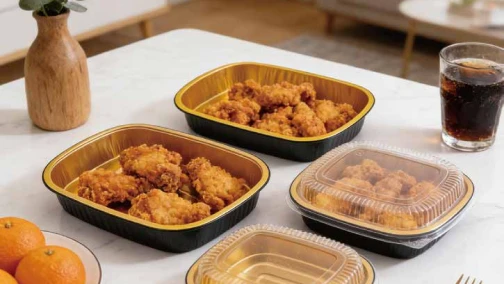


In automated ready-meal production, institutional catering, and cold-chain food distribution, the performance of a package depends heavily on the mechanical interface between the base tray and its closure. Procurement teams and packaging engineers specifying aluminum foil containers with lids must evaluate flange geometry, alloy temper, closure material compatibility, and automated sealing line tolerances. Selecting an incompatible rim profile or lid substrate leads to seal failure during blast chilling, lipid leakage during transit, and high rejection rates on high-speed packaging lines. This technical guide examines the metallurgical and mechanical principles governing aluminum container rim styles, closure materials, Modified Atmosphere Packaging (MAP) hermeticity, and regulatory compliance across European and North American food supply chains.
Rim Metallurgy and Flange Geometry: IVC, HVC, and Smooth-Wall Flanges
The structural integrity of a closed foil tray originates at the rim. During the stamping process, aluminum alloy—typically 8011 or 3003 series in H22 or H24 strain-hardened tempers—is drawn into a three-dimensional cavity. The outer perimeter is simultaneously formed into a specific flange profile designed to accept either a mechanical crimp or a thermal weld.
1. Interrupted Vertical Curl (IVC) and Heavy Vertical Curl (HVC)
Standard wrinkle-wall aluminum containers utilize a vertical flange extension that folds down over the lid edge. In an Interrupted Vertical Curl (IVC) design, the upright aluminum rim features small, engineered notches or ”interruptions” spaced along the perimeter, particularly near the corner radii. When a vertical press head descends during closing, these interruptions prevent metal bunching and corner buckling, allowing the flange to fold flat against a plug-style lid with minimal mechanical force. Heavy Vertical Curl (HVC) rims omit these notches, using a thicker gauge (typically 70 to 120 microns) to provide continuous perimeter compression for heavier food payloads such as family-size lasagnas or catering entrees.
2. Full Curl (FC) and Hemmed Edges
Full Curl rims roll the raw aluminum edge completely under the horizontal flange, forming a smooth tubular bead. Rather than folding over a flat board lid, Full Curl geometries act as a structural retention track for snap-on plastic dome lids. The tubular bead also increases top-load compression strength by up to 35% compared to raw-edge flanges, preventing tray deformation when stacked on Euro pallets.
3. Smooth-Wall Flat Flanges (G-Rim and L-Rim)
Smooth-wall aluminum containers are engineered with a completely flat, wrinkle-free horizontal sealing flange ranging from 5 mm to 8 mm in width. Because the sidewalls and corners undergo deep-drawing without pleating, the flange surface remains microscopically uniform. This flat geometry is mandatory for hermetically heat-sealed lidding films, as any radial wrinkle on the flange creates a capillary channel that compromises vacuum or gas-flush integrity.
Comparative Engineering of Lidding Substrates
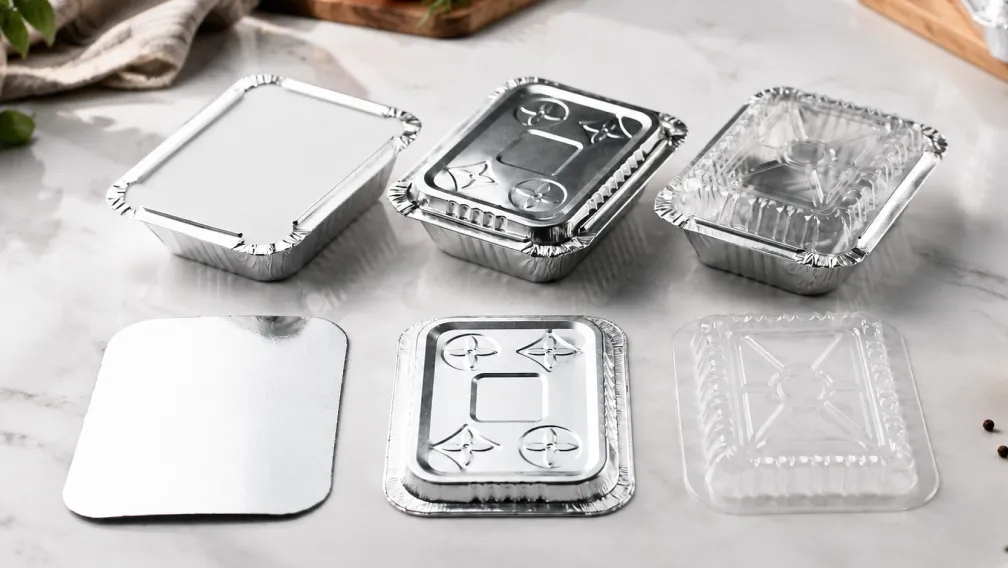
Choosing the correct closure requires balancing thermal exposure limits, moisture barrier requirements, product visibility, and line speed. Commercial food processors rely on four primary lidding architectures.
| Lidding Type | Compatible Rim Style | Thermal Operating Range | Seal Classification | Primary Industrial Application |
|---|---|---|---|---|
| Foil-Laminated Paperboard Lid | IVC / HVC (Wrinkle-Wall) | -40°C to +200°C (Short-term reheat) | Mechanical Crimp (Semi-tight) | Takeaway meals, hot-hold delivery, institutional compartment trays |
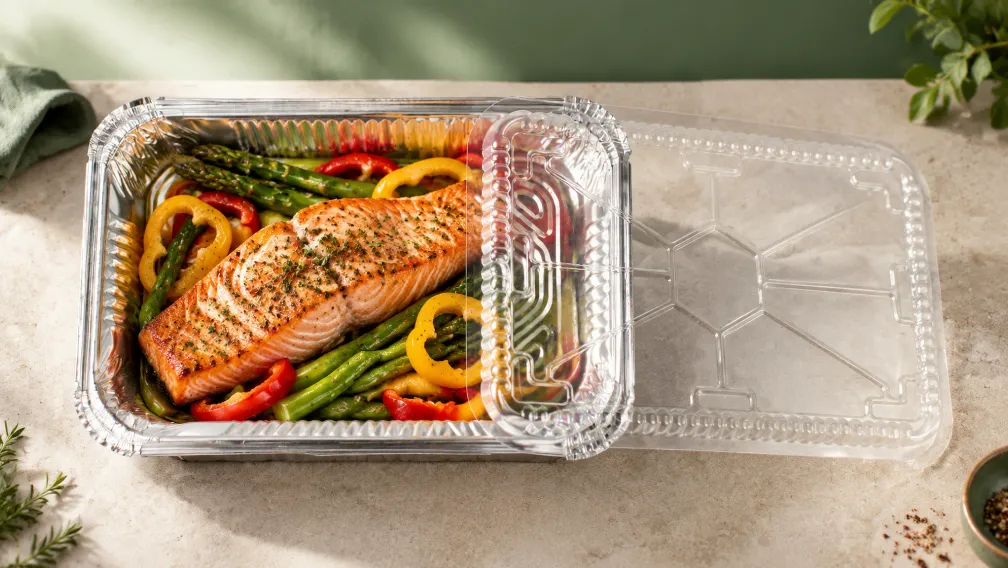
| OPS / PET Clear Dome Lid | Full Curl / IVC | -20°C to +65°C (Remove before oven) | Snap-Fit / Crimp-Over | Retail bakery displays, chilled salads, roasters with dome lids |
| Rigid Aluminum Foil Hood / Lid | Full Curl / HVC | -40°C to +350°C (Full oven & freezer) | Mechanical Crimp | Half-size catering pans, airline casserole inserts, institutional roasting |
| Heat-Seal Polymer Film / Foil | Flat Flange (Smooth-Wall) | -40°C to +220°C (Ovenable CPET/PP film) | Hermetic Thermal Weld | MAP fresh meat, chilled ready meals, extended shelf-life retail packs |
Foil-Laminated Paperboard Lids
Constructed from 300 gsm to 450 gsm solid bleached sulfate (SBS) paperboard laminated on the food-contact side with a 9-to-12-micron layer of aluminum foil or polyethylene (PE), board lids are the economic standard for high-volume foodservice. The paperboard provides structural rigidity for vertical stacking, while the metallic inner face reflects radiant heat and blocks grease absorption. Operators can emboss custom branding or cooking instructions directly onto the upper paperboard surface.

PET and OPS Clear Dome Lids
Retail merchandising often demands 360-degree product visibility and vertical headspace for frosted cakes, roasted poultry, or layered pasta dishes. Polyethylene Terephthalate (PET) and Oriented Polystyrene (OPS) dome lids snap over Full Curl rims or secure beneath IVC folds. Standard PET provides superior clarity and crack resistance at freezer temperatures down to -20°C, whereas OPS offers anti-fog performance in humid deli cases. Because thermoplastic dome lids deform above 65°C–70°C, end-users must remove them prior to conventional oven reheating.
Hermetic Heat-Seal Films and Coated Foil Lids
For central kitchens operating Modified Atmosphere Packaging (MAP) lines, smooth-wall trays are paired with flexible lidding films or die-cut aluminum foil lids pre-coated with a heat-sealable polypropylene (PP) or polyester (PET) lacquer. During the sealing cycle, heated platens (180°C to 220°C) apply 3.5 to 5.0 bar of pressure for 0.8 to 1.5 seconds, fusing the lidding sealant layer directly to the container's polymeric flange coating.
Thermodynamics of Cook-Chill and Blast-Freezing Cycles
In industrial cook-chill workflows, food is cooked inside the aluminum tray, rapidly chilled from +70°C to below +3°C within 90 minutes, stored under refrigeration, and subsequently regenerated in convection or steam-combination ovens. This extreme thermal cycling imposes severe mechanical stress on the container-lid assembly.
Aluminum possesses a thermal conductivity of approximately 235 W/(m·K), which is over 400 times higher than polypropylene or CPET plastic trays. During blast freezing at -40°C, aluminum conducts cold energy rapidly through both the base and sidewalls, accelerating the phase change of water into micro-crystalline ice. Fast freezing prevents the formation of large ice crystals that puncture cellular structures in proteins and sauces.
However, differential thermal contraction between the aluminum tray and non-metallic lids must be managed. Aluminum contracts at a linear coefficient of 23 × 10⁻⁶ /K, whereas polymer films contract at rates two to three times higher. On smooth-wall containers, applying a flexible 15 g/m² PP inner lacquer absorbs this shear stress at the flange interface, preventing seal delamination during deep-freeze storage. For multi-compartment trays, internal divider bridges must be coined to the exact height of the outer flange so that the lidding material seals simultaneously across both the perimeter and internal partitions, eliminating cross-compartment sauce migration during transport.
Automated Closing Line Integration: Denesting and Crimp Tooling
High-speed food production lines operating at 60 to 120 packs per minute require tight dimensional tolerances across both trays and lids. Packaging bottlenecks typically occur at two stations: automatic denesting and mechanical crimping.
- Denesting Geometry: Stacked containers must separate cleanly when pulled by vacuum suction cups or screw denesters. If the rim curl is inconsistent or lacks a precise stacking lug (shoulder offset), trays interlock under pallet pressure, causing double-feeds and line stops.
- Food-Safe Lubrication: During coil stamping, precise micro-application of FDA and EFSA-compliant paraffinic or synthetic ester oils reduces surface friction between nested rims without contaminating the heat-seal flange zone.
- Pneumatic vs. Servo Crimping: In mechanical board-lid closing, the vertical press head depresses the lid slightly into the tray seat while angled wiping fingers fold the IVC/HVC rim inward at a 90-degree angle. If the aluminum temper is too soft (O-temper), the rim uncurls under internal steam pressure during reheating. Specifying H22 or H24 half-hard temper ensures sufficient yield strength (110–145 MPa) to lock the board lid permanently in place during vibratory road freight.
Barrier Metrics: OTR, WVTR, and Shelf-Life Extension
In retail distribution, shelf life is governed by the package's Oxygen Transmission Rate (OTR) and Water Vapor Transmission Rate (WVTR). Bare aluminum foil at thicknesses above 25 microns has an OTR and WVTR of effectively zero (less than 0.005 cm³/m²/day), making the container body a total barrier against light, oxygen, moisture, and microbial ingress.
Consequently, total package permeation is dictated entirely by the closure system. While a crimped paperboard lid permits gas exchange through the folded seam—suitable for 24-to-48-hour chilled delivery—a hermetically heat-sealed smooth-wall tray paired with a high-barrier EVOH co-extruded film or lacquered aluminum foil lid achieves an OTR below 0.5 cm³/m²/day. Flushing the headspace with a 70% N₂ / 30% CO₂ gas mixture prior to heat sealing extends the refrigerated shelf life of fresh poultry, seafood, and prepared meals from 3 days to 14–21 days without chemical preservatives.
EU PPWR Compliance and Mono-Material Recyclability
Under the European Union Packaging and Packaging Waste Regulation (PPWR), packaging producers face strict recyclability performance grades and modulated Extended Producer Responsibility (EPR) fees. Composite closures that permanently bond incompatible plastics to paper or metal complicate municipal sorting streams.
To optimize EPR compliance and circularity, European processors are increasingly specifying mono-material aluminum packaging architectures—pairing an aluminum base tray with a rigid or flexible aluminum foil lid. When disposed of together, the entire package enters the metallic recovery stream via Eddy Current Separation without requiring consumer disassembly. Where transparent polymer lidding films are required for retail display, specifying clean-peel PP or PET sealants ensures that the consumer can strip the thin film cleanly from the smooth-wall flange, leaving less than 1% organic residue on the aluminum body prior to recycling.
Specifying the Optimal Container and Lid System for Your Production Line
Selecting between crimped board lids, clear merchandising domes, and hermetic heat-seal systems requires a systematic audit of your thermal processing parameters, distribution distance, and filling line machinery. Explore our complete range of aluminum foil containers with lids or contact our packaging engineering team to request technical drawings, alloy temper certifications, and sample tooling matched to your automated sealing equipment.
-

SEPACK
Aluminum Foil Packaging Manufacturer
SEPACK supplies aluminum foil containers, rolls, sheets, baking pans, and food wraps to distributors and foodservice businesses in 50+ countries. Headquartered in New York with manufacturing in Shanghai, operating since 2010.