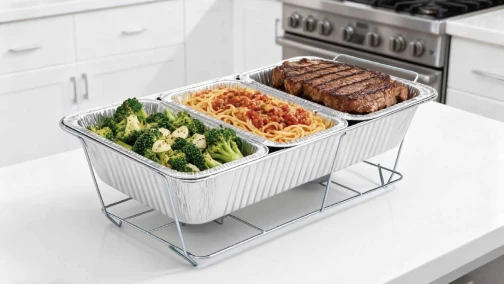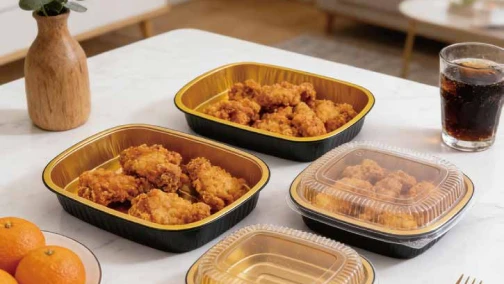


This is one of the most common questions we get from food brands and caterers sourcing foil packaging, and getting it wrong means warped trays, scorched lids, or a cracked dish in the oven. The short version: aluminum foil containers are oven-safe to about 500°F (260°C), freezer-safe to -40°F, and go straight from one to the other without cracking. The microwave is the only real question, and the honest answer there has changed. Below is what happens to a foil container at temperature, which lids survive the oven, and how to use them without trouble — written from the production side, where we test this every day.
Are aluminum foil containers oven-safe?
Yes. Plain aluminum foil containers handle normal baking and roasting heat with no problem. Aluminum melts at over 1200°F, far above any home or commercial oven, so the metal itself is never close to its limit in an oven. What sets the practical ceiling is the gauge — the thickness of the foil — and the food load. As a working rule, a foil container is safe up to around 500°F (260°C), and it holds its shape best when the gauge is matched to the job.
At a standard 350°F cake temperature, a foil pan shows no change after an hour. Roasting at 400°F holds up through a long cook. For anything above 400°F — high-heat roasting, crisping, a hot pizza — a heavier gauge keeps the pan rigid when it is full and hot.
| Foil gauge | Oven use | Best for |
|---|---|---|
| Light / standard | Up to ~400°F | Reheating, light bakes, dry foods |
| Heavy-duty | Up to ~500°F | Roasting, crisping, heavy or wet foods |
| Extra-heavy | Up to ~500°F | Turkeys, large roasts, full liquid loads |
The lid is the part that burns
The container survives the oven. The lid is where people get caught. The rule is simple: aluminum and foil lids go in the oven; board and plastic lids do not.
| Lid type | Oven-safe? | What to do |
|---|---|---|
| Aluminum / foil lid | Yes | Leave on to cover; rated for oven heat |
| Board / cardboard lid | No | Remove — degrades by ~250°F, chars by ~350°F |
| Clear plastic / dome lid | No | Remove — melts |
Board and foil-board lids start to break down around 250°F and can scorch by 350°F, so they come off before the tray goes in. Clear plastic and dome lids melt. If you need to cover food in the oven, use an aluminum lid or a sheet of aluminum foil instead. Our containers with lids pair each tray with the right lid for the job, including foil lids made for oven use.
Freezer to oven, no thaw
Foil containers are freezer-safe to -40°F, and the same tray goes from the freezer straight into a hot oven. This is the property meal-prep brands and frozen-food lines are really buying. Aluminum conducts heat about 200 times faster than glass or ceramic, so it absorbs a sudden temperature change instead of cracking under it. A glass dish can shatter going from freezer to a hot oven; a foil tray does not. Add five to ten minutes to the cook time when you start from frozen, and the meal bakes in the pan it was frozen in.
Can you microwave aluminum foil containers?
This is where the old advice and the current evidence disagree, so here is the straight answer. Most of us grew up with one rule: never put metal in the microwave. That rule came from older microwaves and older trays — crinkled foil and tall, jagged edges acted like antennas, concentrated the charge, and threw sparks. It was sound advice for that equipment.
The picture today is different. A study run for the European Aluminium Foil Association at the Fraunhofer Institute heated more than 200 food portions in foil trays at full power across several microwaves and found it worked, with no damage to the ovens and no hazard to users. Modern trays with smooth, rolled rims do not arc the way old ones did, and a foil tray shields the edges of the food from overcooking.
The conditions are what matter. If you do microwave in foil: use a shallow tray with a wide opening, fill it at least two-thirds with food, keep it centered and at least an inch from the walls and the door, run one tray at a time, and take off any foil or board lid first. Even so, consumer microwaves and their manuals vary, and some still advise against metal. For a mixed customer base, the safe instruction to print on a pack is still to reheat in the oven, or to lift the food into a microwave-safe dish. The capability is real; a blanket guarantee across every home microwave is not.
Acidic and salty foods
Aluminum reacts slowly with acidic and salty foods — tomato sauce, citrus, vinegar, brine. For a quick bake or a single serving it is a non-issue. Over long storage or long contact the food can pick up a metallic note and the surface can dull. The fix on the production side is a food-safe lacquer on the foil, which puts a barrier between the metal and the food. If your product is a tomato-based lasagna or a brined dish meant to sit for days, ask for a coated container.
A few rules that keep trays out of trouble
- Use a heavier gauge above 400°F and for heavy, wet or liquid foods.
- Take board and plastic lids off before the oven; keep foil and aluminum lids on if you want a cover.
- Support a full tray on a baking sheet when you move it in and out — foil is light and a loaded tray flexes.
- Keep trays off direct stovetop burners and open flame; a closed grill can reach foil’s melting point.
- For acidic or salty foods held a long time, use a coated container.
- Leave airflow if you line an oven rack — cover the pan area, not the whole rack.
Matching the container to the heat
Most oven problems trace back to the wrong container for the temperature and the load, not to a flaw in the foil. A few pointers from what we supply:
- Wrinkle-wall containers are the everyday workhorse for takeaway and reheating — the ridged wall adds strength at a low cost.
- Smooth-wall containers use a heavier, stronger alloy and hold their shape and finish through a reheat, which is why retail ready-meals and airline catering use them.
- For a turkey or a heavy roast, a heavy-gauge roasting pan with handles holds a full, hot load without buckling.
- For cakes, bread and bakery work, foil baking pans give the even heat that browns food evenly.
All of them are plain aluminum, oven- and freezer-safe, and fully recyclable — aluminum recycles indefinitely and takes about 95% less energy to recycle than to make new.
Sourcing foil containers for a food line? We manufacture the full range — wrinkle-wall, smooth-wall, lidded and use-case pans — in food-grade alloys, with FDA, BRC, ISO and SGS certification and OEM and private-label options. Tell us your dish, your temperature and your volume, and we will spec the right gauge, shape and lid and send samples. Start with our aluminum foil containers range.
FAQ
Can you put an aluminum foil pan in the oven?
Yes. Plain aluminum foil pans are oven-safe to about 500°F (260°C). Remove any board or plastic lid first, use a heavier gauge above 400°F, and support a full pan on a baking sheet when you move it.
What temperature can aluminum foil containers handle?
Up to around 500°F (260°C) for the container. At 350°F they show no change over an hour; above 400°F a heavy-duty gauge holds shape best. The foil itself melts only above 1200°F, which a closed grill can reach but an oven cannot.
Are aluminum foil containers freezer-safe?
Yes, to -40°F (-40°C), and they go from freezer straight to oven with no thaw. Aluminum’s fast heat conduction means no thermal shock, unlike glass. Add five to ten minutes to the cook time from frozen.
Can you microwave aluminum foil containers?
It can be done, and European research has shown it is viable in shallow, smooth-rimmed trays under the right conditions — filled at least two-thirds, centered, an inch from the walls, no metal lid, one tray at a time. But microwaves and their manuals vary, so the safe default for most users is to reheat in the oven or transfer to a microwave-safe dish.
Do you remove the lid before putting a foil container in the oven?
Remove board, cardboard and plastic lids — they char or melt. Aluminum and foil lids can stay on. To cover food in the oven, use an aluminum lid or a sheet of foil.
Can you put acidic foods like tomato sauce or lasagna in aluminum?
For a quick bake, yes. For long storage or long contact, acidic and salty foods can react with bare aluminum and pick up a metallic taste. Use a lacquered or coated container for those.
Can aluminum foil containers be reused, and are they recyclable?
Heavy-duty trays can be washed and reused a few times if they are not dented or torn; light trays are single-use. Either way they are 100% recyclable, and aluminum can be recycled indefinitely without losing quality.
-

SEPACK
Aluminum Foil Packaging Manufacturer
SEPACK supplies aluminum foil containers, rolls, sheets, baking pans, and food wraps to distributors and foodservice businesses in 50+ countries. Headquartered in New York with manufacturing in Shanghai, operating since 2010.