

Meal prep lives or dies on the container. A portioned meal has to freeze solid, survive a week or more in the freezer, reheat without warping, and still look like food the customer wants to eat. Aluminum foil containers are the standard for that job, which is why most meal-prep operations and frozen-meal brands run on them. This guide walks through the sizes, the lid choices, single versus divided trays, and the freezer-to-oven workflow — from the side that makes them.
Why meal-prep operations use foil containers
The reason comes down to one workflow: assemble, freeze, reheat, in the same container. Aluminum handles that whole range. It is freezer-safe down to -40°F with no change to the tray, and it goes straight into a hot oven without the thermal shock that cracks glass or the warping that ruins plastic in heat. It conducts heat quickly and evenly, so a frozen meal reheats through without a cold center. The tray is light, stackable, brandable, and recyclable. For a business shipping portioned meals, that combination is hard to match with any other material.
Choosing the right size
Portion size drives the container size, and a handful of sizes cover most meal-prep menus. The 2.25 lb oblong is the workhorse for a standard adult meal — an entree with sides. Lighter or weight-management portions use a 1 lb or 1.5 lb tray. Family-size or bulk dishes move up to 4 or 5 lb. Picking the size to the portion keeps the tray looking full, which matters: a half-empty container reads as a smaller meal and flexes more in handling.
| Container size | Portion | Typical use |
|---|---|---|
| 1 lb | Small / side | Light meals, weight-management, sides |
| 1.5 lb | Light entree | Smaller adult portions |
| 2.25 lb oblong | Standard adult | Entree plus sides (the workhorse) |
| 4 – 5 lb | Family / bulk | Shareable or large dishes |
Single tray or divided tray
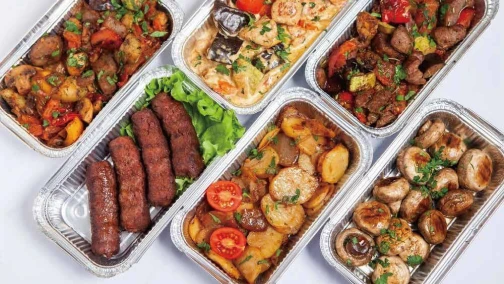
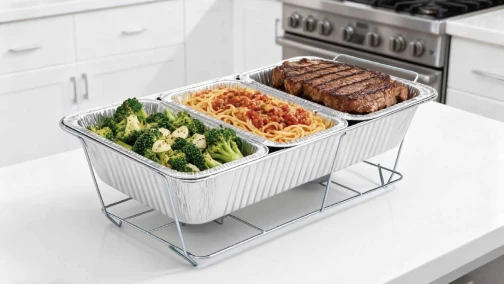
The other size question is whether the meal needs sections. A single-compartment tray suits one-dish meals — a pasta, a curry, a casserole. A divided tray keeps components apart, and the common format is three compartments: one large section for the entree and two smaller ones for sides, so the protein, starch, and vegetable do not run together or trade moisture. For portion-controlled and fitness meals, the divided tray does the portioning for you. Both formats are oven- and freezer-safe.
The lid decides the workflow
The lid is not an afterthought in meal prep — it sets how the meal is stored, labeled, and reheated. Three types cover most operations.
| Lid type | Oven-safe? | Best for |
|---|---|---|
| Board (foil-laminated) | No — remove first | Freezer storage, labeling and instructions |
| Full aluminum / foil | Yes | Oven reheating with lid on, moisture-sensitive meals |
| PET dome | No | Salads, grain bowls, cold or display meals |
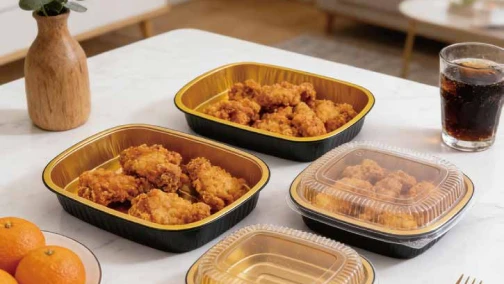
Board lids, usually foil-laminated, are the most common because they are inexpensive and you can write the meal name, date, and heating instructions right on top with a marker. They are not oven-safe, so the customer removes them before reheating. Full aluminum lids seal completely and go in the oven, so the customer reheats without taking the lid off — good for moisture-sensitive meals. Clear PET dome lids show the food, which suits salads, grain bowls, and cold or display-focused meals, though they are not for the oven or long freezing.
The freezer-to-oven workflow
Here is the workflow most meal-prep brands print on the pack. The meal is assembled into the tray, sealed under a lid, and frozen — aluminum holds at -40°F indefinitely with no structural change. To reheat from frozen, the oven goes to around 350 to 375°F, the customer removes any board or plastic lid (or leaves a foil lid on), and the meal bakes for roughly 35 to 45 minutes until the center reaches 165°F. Higher heat, around 400°F and up, is for dishes that need browning or a crisp top. One point to make clear on the label: foil trays are not for the microwave, so the instruction is oven reheating or a transfer to a microwave-safe dish.
Smooth wall or wrinkle wall for a meal-prep brand
For a brand that ships to customers, the wall type is a presentation and margin decision. Smooth-wall containers have clean, flat sides that read as restaurant quality, take a printed or labeled finish well, and hold their shape and look through a reheat — which is why premium meal-prep and ready-meal lines use them, often in a black-and-gold finish for a home-meal-replacement look. Wrinkle-wall containers, with their ridged sides, are the economical workhorse for high-volume, price-sensitive programs. Smooth wall costs more per tray; the question is whether the presentation earns it back in what customers will pay and how often they reorder.
Sourcing for a meal-prep business
On the buying side, the path usually runs from cash-and-carry packs to wholesale distributors to a manufacturer as volume grows — many operations make the move to factory-direct around the point where they are using a thousand or more units a week, where the per-tray saving and the ability to customize start to matter. At that stage, custom printing and private label put the brand on the tray, and food-grade certification — FDA, Kosher, ISO, BRC — becomes part of the spec rather than a nice-to-have. Container cost feeds straight into meal margin, so matching the tray, gauge, and lid to the menu is worth getting right.
Building or scaling a meal-prep line? We manufacture the full meal-prep range — single and 3-compartment trays, smooth-wall and wrinkle-wall, in meal-prep sizes, with board, foil, and dome lids, plus custom printing and private label. Everything is food-grade and certified to FDA, BRC, ISO and SGS. Tell us your menu, portions, and volume, and we will spec the trays and lids and send samples.
FAQ
What size aluminum container is best for meal prep?
For a standard adult meal, a 2.25 lb oblong tray is the common choice. Lighter or weight-management portions use 1 lb or 1.5 lb; family or bulk dishes use 4 to 5 lb. Match the size to the portion so the tray looks full and handles well.
Can you freeze and reheat a meal in the same foil container?
Yes — that is the main reason meal-prep brands use them. Foil holds at -40°F in the freezer and goes straight to the oven with no thermal shock. Reheat from frozen at about 350 to 375°F for 35 to 45 minutes, to a center temperature of 165°F.
Are 3-compartment foil trays good for meal prep?
Yes. A three-compartment tray keeps an entree and two sides separate, which is ideal for portion-controlled and fitness meals. The sections stop foods from mixing or trading moisture, and the tray is oven- and freezer-safe.
Can meal-prep foil containers go in the microwave?
They are not recommended for the microwave because of the risk of sparking. The standard instruction for a frozen meal is to reheat in the oven, or to transfer the food to a microwave-safe dish.
Which lid is best for meal prep?
A foil-laminated board lid is most common — inexpensive and writable for labeling, but removed before the oven. A full aluminum lid seals and is oven-safe, so the meal reheats with the lid on. A PET dome lid suits cold or display meals like salads and bowls.
Should a meal-prep brand use smooth-wall or wrinkle-wall containers?
Smooth-wall trays look premium, brand well, and hold their shape through reheating, which suits customer-facing and premium lines. Wrinkle-wall trays cost less and suit high-volume, price-sensitive programs. The choice is presentation and margin.
-

SEPACK
Aluminum Foil Packaging Manufacturer
SEPACK supplies aluminum foil containers, rolls, sheets, baking pans, and food wraps to distributors and foodservice businesses in 50+ countries. Headquartered in New York with manufacturing in Shanghai, operating since 2010.