

Institutional foodservice in Europe—encompassing aviation catering, healthcare facilities, military logistics, and municipal "Meals on Wheels" programs—operates on strict dietary compliance and hyper-efficient thermal regeneration. In these high-volume closed-loop environments, cross-contamination between meal components is unacceptable, and the cold-chain logistics are unforgiving. To execute precise portion control while surviving the rigors of cook-chill and cook-freeze systems, procurement engineers rely heavily on aluminum compartment trays. Transitioning from legacy CPET (Crystallized Polyethylene Terephthalate) plastics to multi-cavity aluminum demands a deep understanding of drawing metallurgy, co-planar flange sealing, and European public procurement mandates.

The Metallurgy of Internal Divider Walls
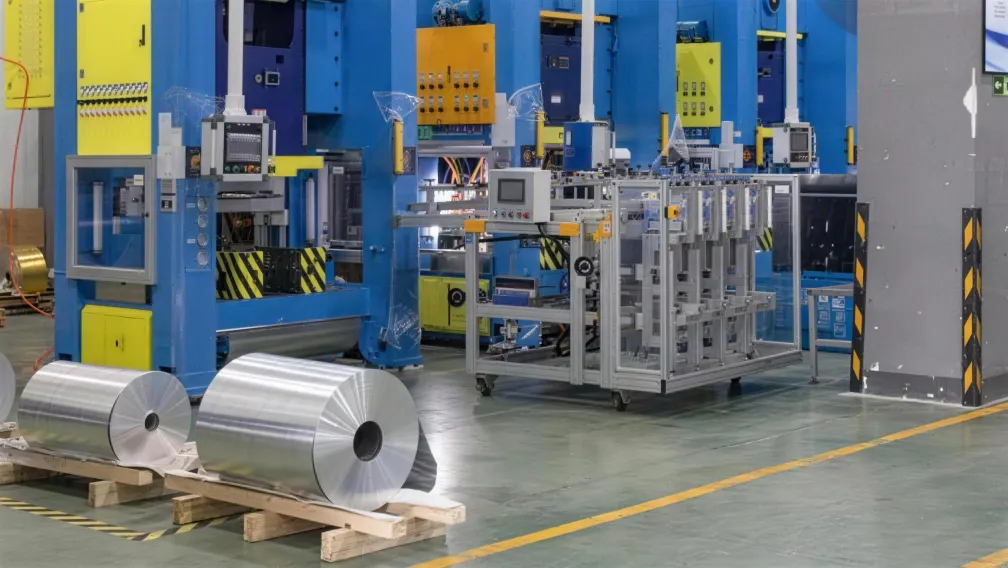
Manufacturing a standard single-cavity aluminum tray requires pushing metal into a single void. Stamping a two-compartment or three-compartment tray introduces severe metallurgical complexities. As the mechanical press descends, the punch forces the flat aluminum coil into multiple adjacent cavities simultaneously. The metal must stretch and flow over the internal divider ridges without "necking" (thinning out dangerously) or tearing at the Y-junctions where three compartments meet.
This complex mechanical displacement dictates strict alloy selection. Standard 8011 aluminum, commonly used for shallow takeaway pans, often lacks the elongation properties required for deep-drawn multi-compartment geometries. For rigid institutional trays, engineers specify either 3003 alloy in an H24 temper for wrinkle-wall applications or the highly ductile 8006 alloy in an O-temper for smooth-wall applications. The 3003 alloy provides superior tensile strength, ensuring that the internal divider walls act as structural beams, preventing the tray from twisting or buckling when a nurse or flight attendant lifts a fully loaded meal by one corner.
Co-Planar Flanges and Compartment Isolation Sealing
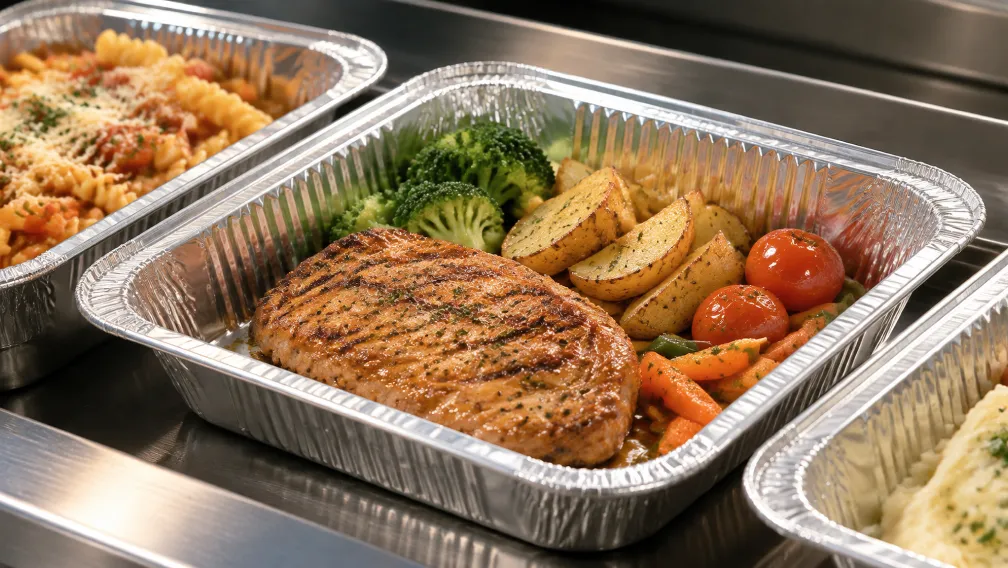
The primary function of a compartment tray is isolation—keeping a high-moisture component (like gravy or tomato sauce) from destroying the texture of a dry component (like roasted potatoes or rice). Achieving this isolation during transport and handling requires a hermetic or semi-hermetic seal that bonds not just to the outer perimeter of the tray, but to every internal divider wall.
This necessitates absolute co-planarity. During the stamping process, the die must ensure that the top ridge of every internal divider is perfectly level with the outer rim (the flange). If an internal divider is stamped even 0.5mm lower than the outer rim, the lidding material will not make contact, resulting in internal liquid migration.
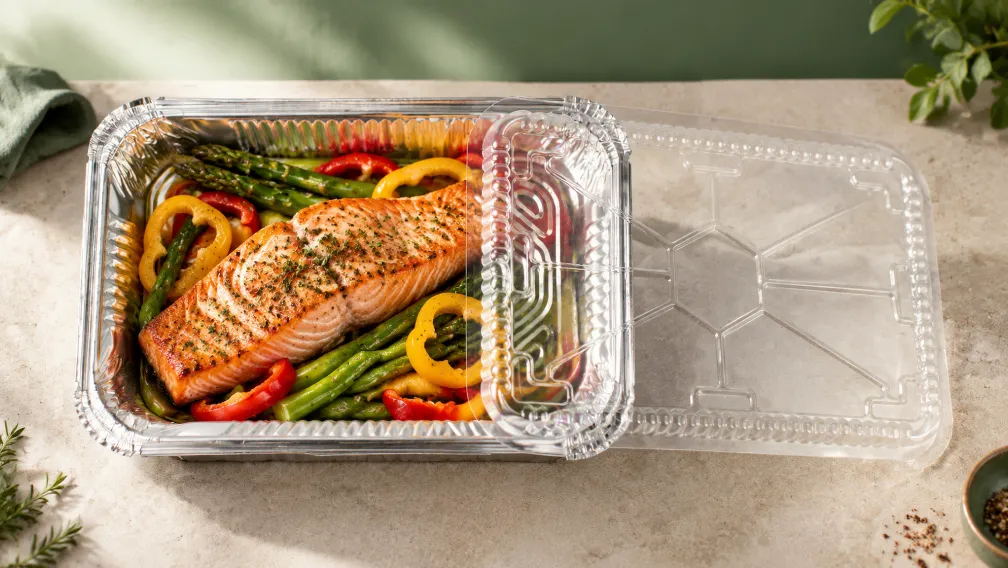
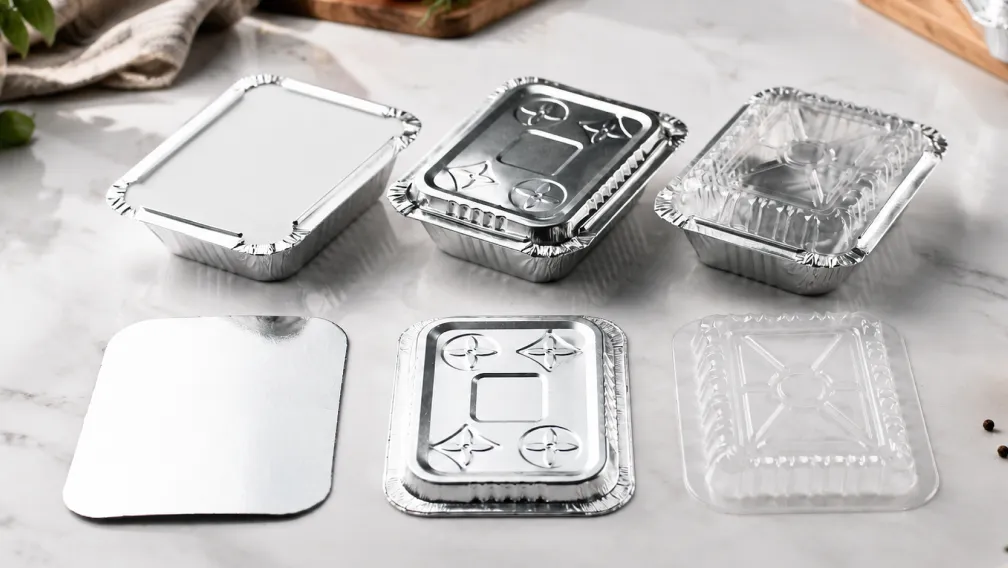
For high-speed aviation and hospital lines, this co-planar geometry interfaces with two distinct lidding systems. In standard wrinkle-wall compartment trays, a rigid foil-laminated board is placed over the tray, and a mechanical crimping machine folds the aluminum edge over the board (Interrupting Vertical Lidding). The foil board presses firmly against the co-planar dividers. In premium smooth-wall compartment trays, the uninterrupted flat flange and dividers are coated with a heat-seal lacquer. A heated die descends, melting a polymer film directly onto the perimeter and internal ridges simultaneously, achieving a liquid-tight, hermetic seal capable of surviving the violent vibrations of aviation turbulence.
Thermal Regeneration Mechanics in Aviation and Healthcare
Institutional meals are almost exclusively processed using cook-chill or cook-freeze protocols. The meals are assembled in central kitchens, rapidly chilled to below 4°C, distributed to satellite locations (hospitals, aircraft galleys), and then "regenerated" (reheated) immediately before consumption.
Aluminum possesses a thermal conductivity rating of approximately 235 W/(m·K), outperforming standard CPET plastics (0.2 W/(m·K)) by orders of magnitude. In aviation, meals are regenerated in specialized convection ovens built to the ATLAS standard, operating at high temperatures to reheat hundreds of meals within 20 minutes. Aluminum compartment trays instantly absorb this convection heat and transfer it evenly into the food mass. The internal divider walls act as integrated thermal heat sinks, conducting heat deep into the center of the tray where cold spots typically form. This guarantees that the core temperature of every compartment rapidly exceeds the 75°C threshold required by HACCP (Hazard Analysis Critical Control Point) regulations to eliminate pathogens like Listeria.
In European healthcare settings, hospitals frequently utilize induction or contact-heating trolleys. The bottom of the aluminum tray sits directly on a heating plate. The exceptional conductivity of the metal ensures immediate thermal transfer, while the low thermal mass of aluminum means the tray edges cool down within seconds of being removed from the heat source, protecting patients from contact burns.
Furthermore, because the compartments isolate the food types, dietary planners can calculate precise thermal regeneration curves. A dense protein in the large compartment and a light vegetable in the smaller compartment will heat at different rates; the aluminum dividers help manage this thermal bridging, ensuring the meat is safe while preventing the vegetables from turning to mush.
ATLAS and KSSU Standardization in Airline Catering
The aviation catering supply chain operates on rigid dimensional constraints governed by international galley standards, primarily the ATLAS and KSSU guidelines. Every millimeter of a compartment tray is engineered to fit standard airline oven racks and meal carts.
A standard ATLAS half-tray format requires precise external dimensions (typically around 160mm x 100mm to 160x110mm depending on the exact specification) so that meals can be slotted into the rails of the galley oven without jamming or wasting cubic space. Multi-compartment aluminum trays are engineered specifically for these dimensions. By utilizing lightweight aluminum (weighing only a few grams per tray), airlines achieve a massive reduction in Maximum Takeoff Weight (MTOW) compared to reusable rotable plastic trays. Shaving even 5 grams per meal across an international fleet carrying millions of passengers annually translates directly into thousands of tons of saved aviation fuel and significant reductions in Scope 1 carbon emissions.
EU Green Public Procurement (GPP) and EPR Compliance
For European municipalities operating "Meals on Wheels" programs and public hospitals, packaging procurement is heavily dictated by the European Union’s Green Public Procurement (GPP) criteria. These guidelines explicitly penalize the use of single-use, multi-layer plastics due to their dismal end-of-life recycling rates. Institutional buyers face massive Extended Producer Responsibility (EPR) taxes if they specify black CPET or PP (polypropylene) compartment trays.
Aluminum offers a completely closed-loop solution that satisfies stringent EU environmental mandates. As a permanent material, aluminum does not degrade during the recycling process. When municipal or hospital waste is processed, Materials Recovery Facilities (MRFs) utilize Eddy Current Separators (ECS) to magnetically eject the aluminum compartment trays from the general waste stream with near-100% efficiency. Remelting these post-consumer trays into new aluminum coils requires only 5% of the energy utilized in primary aluminum smelting.
Consequently, aluminum packaging is subjected to significantly lower EPR taxation brackets across EU member states (such as Germany's VerpackG or France's CITEO fee structures). For a centralized hospital catering operation processing 10,000 meals daily, the reduction in EPR taxes achieved by switching to aluminum compartment trays frequently offsets any marginal increase in unit packaging costs.
Specifying the Right Architecture for Your Menu
Selecting the correct multi-compartment tray requires aligning the tray’s physical architecture with the dietary and logistical realities of the institutional menu. Procurement engineers must evaluate the volumetric ratio between compartments (e.g., 60/40 splits for meat/starch, or three-cavity 50/25/25 splits for complex diets), the draw depth required to contain wet sauces without splashing, and the specific lidding machinery available at the central kitchen.
Whether executing heat-sealed smooth-wall trays for turbulence-proof aviation catering or heavy-gauge wrinkle-wall trays with foil boards for municipal meal delivery, sourcing requires rigorous metallurgical standards. By integrating precision-stamped aluminum compartment trays, European institutional caterers guarantee HACCP thermal compliance, eliminate cross-contamination, and insulate their operations against escalating plastic EPR taxes.
-

SEPACK
Aluminum Foil Packaging Manufacturer
SEPACK supplies aluminum foil containers, rolls, sheets, baking pans, and food wraps to distributors and foodservice businesses in 50+ countries. Headquartered in New York with manufacturing in Shanghai, operating since 2010.