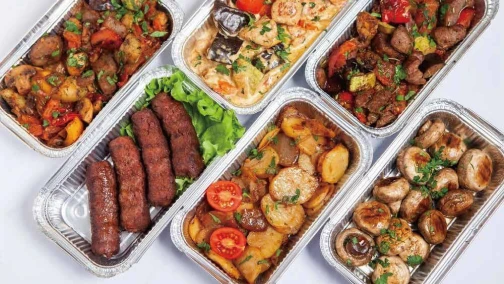


Catering runs on a simple chain: cook off-site, move the food hot, hold it through service, and serve at volume — often for hundreds of people. Disposable aluminum steam table pans are the backbone of that chain, which is why caterers, banquet kitchens, and institutional foodservice stock them by the case. This guide covers the pan sizes, how they fit a chafing rack, why depth matters, the lid and gauge choices, and how to buy them — from the side that makes them.
Why caterers run on foil pans
A few things make foil the default for off-site service. Aluminum conducts heat well, so a pan holds food temperature in a chafer through a long buffet. The pans are rigid enough to carry a heavy, full dish without bending, and the curled rim keeps liquids from sloshing out in transit. They go from oven to chafing rack to table, then get tossed — no washing, no scrubbing, no chasing pans back from a venue. For an operation feeding a crowd and breaking down fast at the end, that disposability is worth as much as the performance.
The steam table pan sizes
Catering pans follow a standard sizing system, named by their fraction of a full pan. The full and half sizes do most of the work; the smaller sizes hold sides and condiments.
| Pan size | Approx. dimensions | Feeds | Typical use |
|---|---|---|---|
| Full | 21" x 13" | 30 – 50 | Large entrees, high-volume events |
| Half | 12.75" x 10.5" | 15 – 25 | Buffet default; fits a chafing rack |
| Third | 12.75" x 6.875" | — | Sides on a hot or cold bar |
| Quarter | 8.5" x 6.5" | — | Individual portions, condiments |
| Sixth / ninth | Smaller | — | Toppings, dressings, garnishes |
The half pan is the one most caterers stock deepest, because it fits a standard chafing rack and lets you run two dishes per rack instead of one. The full pan is for high-volume entrees and large events; the third, quarter, and smaller pans handle sides, toppings, and dressings on a hot or cold bar.
How the pans fit a chafing rack
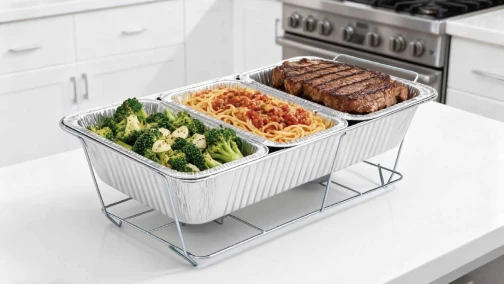
A chafing setup is a wire rack, a water pan, fuel canisters underneath, and the food pan on top. The rule that trips up first-time caterers: a standard rack holds one full pan or two half pans. That is why half pans are the buffet default — two halves let you offer two dishes from one rack and swap one without disturbing the other. The fuel keeps the water pan hot, the water keeps the food pan hot, and the food stays at serving temperature for hours.
Why depth matters
Each size comes in several depths — shallow, medium, deep, and extra-deep — and the footprint stays the same, so a deep half pan drops into the same rack as a shallow one. Only the capacity changes. Two reasons to go deeper for catering: a deeper pan holds more food, and more food holds heat longer, which means fewer refills and less labor over a long service. Shallow pans suit sides and items you replenish often; deep and extra-deep pans suit mains, saucy dishes, and high-volume lines.
Lids for transport and holding
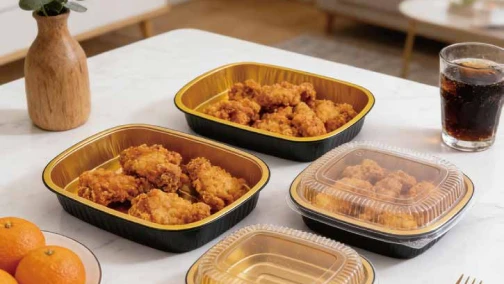
Lids do double duty in catering: they seal heat in during transport and let pans stack on a cart. Foil and board lids with a full curl crimp onto the pan, hold temperature on the road, and stack flat so a cart carries several dishes at once. Clear dome lids are for display — a cold bar or a dessert station where guests see the food. The full-curl rim on the pan also makes for a cleaner, safer edge to handle and a better seal with the lid.
Gauge: why catering needs heavy-duty
Gauge is the thickness of the foil, and catering is where it earns its place. A heavy-duty pan holds a full load of solids and liquids — a tray of lasagna, ribs in sauce, a deep pan of stew — through cooking, transport, and a long hold without buckling or springing a leak. A light pan that is fine for a dry side will flex and spill under a heavy, wet dish. For event work, heavy-duty gauge with a full-curl rim is the spec that holds up from the kitchen to the last guest.
The catering workflow
Most catering jobs run the same path. Food is cooked in the pan or transferred into it hot, covered with a foil or board lid, and loaded onto a cart. At the venue, the pan goes into a chafing rack over a lit fuel canister and a hot water pan, and it holds at serving temperature through the event, refilled as it empties. For make-ahead work, the same pans take a dish from the freezer at -40°F straight into the oven, no thaw. The one limit to flag for staff: foil pans are for the oven and chafer, not the microwave.
Buying foil pans for catering
On the buying side, catering is a case-quantity game. Single packs from a grocery store run several times the per-pan price of a wholesale case, so caterers and kitchens stock the sizes they use — usually half pans, plus fulls and a range of small sizes — by the case. Above a steady volume, going factory-direct adds custom options and private label, and food-grade certification — FDA, BRC, ISO — comes standard. Matching size, depth, gauge, and lid to the menu keeps both the food and the margin where they should be.
Stocking foil pans for a catering or foodservice operation? We manufacture the full steam table range — full, half, third, and quarter sizes in shallow to extra-deep, with matching foil, board, and dome lids, all in heavy-duty, food-grade aluminum certified to FDA, BRC, ISO and SGS. Tell us your sizes and volume, and we will spec the pans and lids and send samples.
FAQ
What size is a half tray aluminum pan?
A half-size foil pan measures roughly 12.75 by 10.5 inches and feeds about 15 to 25 people, depending on depth and dish. It fits a standard chafing rack, which is why it is the catering default — a rack holds two half pans or one full pan.
How big is a full size foil pan, and how many people does it feed?
A full-size pan is about 21 by 13 inches and feeds roughly 30 to 50 people. It is the standard for large entrees and high-volume events, and it fills a full chafing rack on its own.
What is the difference between a quarter pan and a half pan?
A quarter pan is about 8.5 by 6.5 inches — half the footprint of a half pan — and is used for individual portions, condiments, and food-truck service. Half pans are the catering standard for sides and mains.
What size foil pan fits a chafing rack?
A standard chafing rack holds one full pan or two half pans. Half pans are the most common choice because they let you serve two dishes per rack. Depth does not change the fit — a deep half pan sits in the same rack as a shallow one.
Are catering foil pans oven- and freezer-safe?
Yes. Heavy-duty foil pans are oven-safe to around 400 to 500°F and freezer-safe to -40°F, so a dish can go from freezer to oven for make-ahead service. They are not for the microwave.
How deep should a catering pan be?
Shallow pans suit sides and frequently refilled items; deep and extra-deep pans suit mains, saucy dishes, and high-volume lines, because they hold more food and keep it hot longer with fewer refills. The footprint is the same across depths.
-

SEPACK
Aluminum Foil Packaging Manufacturer
SEPACK supplies aluminum foil containers, rolls, sheets, baking pans, and food wraps to distributors and foodservice businesses in 50+ countries. Headquartered in New York with manufacturing in Shanghai, operating since 2010.